



Air quality can change after the gates open
A clear opening morning does not settle the air-quality question for the rest of the day. In a hypothetical August fair, conditions deteriorate while families are eating and vendors are preparing the evening rush. The concession manager sees one reading, a supervisor sees another, and guests ask whether they should stay. Without a decision plan, staff may offer reassuring guesses while management works out who owns the call. A fair air quality operations plan names that owner in advance.
The answer is not to turn every food-stand employee into an air-quality expert. It is to establish reliable monitoring, a named decision owner, practical service adjustments, and messages that follow public-health guidance. As of August 2025, California fairs also need to distinguish guest recommendations from employer obligations. Those are related responsibilities, but they are not interchangeable, and one number should not be treated as an automatic answer to every operational question.
Read the index before making the message
The AirNow AQI basics explain the color-coded Air Quality Index and its health categories. Higher values indicate greater concern, with some groups affected before the general public. Identify the pollutant and the type of reading being used. A daily forecast and a current observation are not the same thing, and a reading from a distant location may not describe conditions on the grounds.
Assign a person to check appropriate official information and record the source, location, time, pollutant, and result. That makes it possible to explain why a decision changed without arguing over unlabeled screenshots. Use local air-district and public-health instructions when available. Do not promise that a particular color guarantees comfort or safety for every visitor. People have different health needs, and guests should be able to make informed choices based on clear information rather than marketing language.
Name the person who runs the fair air quality operations plan
The air-quality lead needs a direct path to the person authorized to modify the event. Decide in advance who can pause a food area, relocate an activity, shorten service, or recommend broader action through the fair’s emergency structure. Include a backup so a meal break does not interrupt the decision chain.
Use the same discipline that the National Weather Service recommends for outdoor-event monitoring: someone must watch conditions and know how to trigger a response. The specific hazard is different, but the ownership problem is familiar. Write down the information required for a decision, the people consulted, and the communication sequence. A concession operator should not make unsupported promises about the entire fair, and the fair should not leave individual vendors guessing whether service adjustments are coordinated or optional. Clear authority prevents a collection of inconsistent local decisions.
Build guest actions around public-health advice
Consult the 2019 Wildfire Smoke guide for public-health officials when developing the plan with local health partners. Identify how the fair will communicate changing conditions, direct visitors to available lower-exposure spaces, and support people who choose to leave. Do not use a food-court awning as evidence of protection from smoke. Shade and smoke exposure are different issues.
Write message templates before they are needed, with fields for the current information and the action being taken. Avoid claims that the grounds are “safe for everyone” or that people with health concerns can simply remain outside if they take a break. A useful message states what is known, cites the official information channel, and explains available options. The fair’s role is to support informed decisions and implement its plan, not diagnose individual visitors or replace their medical advice.
Separate employee protections from guest messaging
California’s Cal/OSHA wildfire-smoke standard, Section 5141.1 applies when the current PM2.5 AQI is at least 151 and the employer should reasonably anticipate employee exposure to wildfire smoke, subject to the standard’s exemptions. That is a workplace rule with defined requirements, not a universal public-event cancellation threshold. Do not use it as the sole basis for deciding what every guest should do.
Each employer needs to understand the standard’s application to its workers. A fair should coordinate expectations with concession vendors without assuming that a contract transfers away statutory responsibilities. Confirm who monitors exposure information, communicates with employees, provides required training and controls, and documents implementation. The fair’s own workers and vendor employees may have different employers, but their protection plans still need to fit the same changing conditions and the same practical grounds layout.
Use the full control framework, not just a box of masks
Section 5141.1 calls for engineering controls where feasible and administrative controls where practicable when engineering measures are insufficient or infeasible. The regulation discusses filtered enclosed spaces, relocation, schedule changes, reduced intensity, and additional rest opportunities. Evaluate these through qualified safety personnel and the requirements applicable to the actual work; a generic checklist is not a compliance determination.
For covered work at current PM2.5 AQI from 151 through 500, the standard requires sufficient NIOSH-approved respirators for voluntary use and encouragement to use them. Above 500, required respirator use brings further respiratory-protection requirements. Review the full regulatory text rather than reducing the program to handing out face coverings. Ordinary cloth masks are not equivalent to the specified respirators. Staff also need understandable information about hazards and protective measures, and a way to report concerns without fear of reprisal.
Prepare lower-exposure spaces realistically
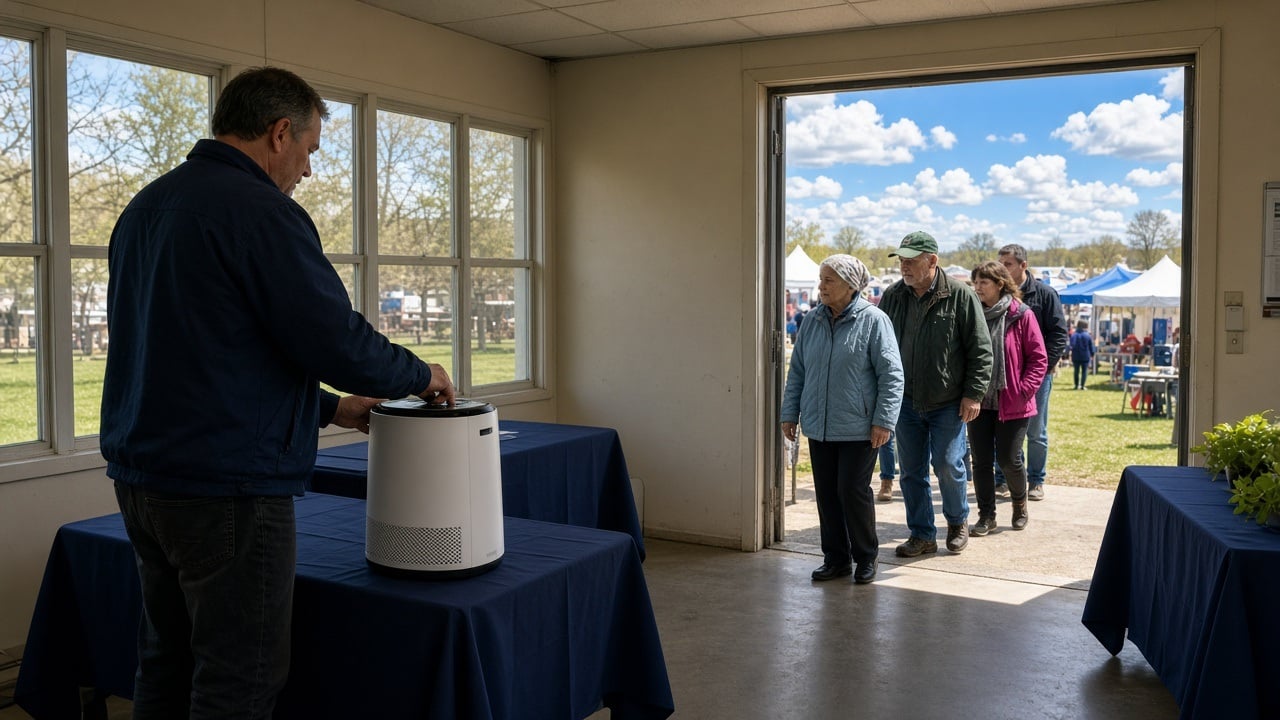
If the fair plans to offer an indoor refuge, assess the building and its air-handling capability before listing it in public messages. An enclosed room is not automatically a clean-air space, especially if doors remain open or ventilation brings outdoor smoke inside. Seek facilities and public-health advice on filtration, capacity, and operating procedures suitable for the building.
Plan seating, accessible entry, staffing, and communication inside the space. Decide how guests find it from the food court and how staff avoid overcrowding or blocking exits. Do not advertise a medical-grade environment unless there is an appropriate basis for that claim. The public-health guide discusses exposure reduction, not a guarantee that any improvised indoor area eliminates risk. A modest, accurately described option is more useful than a reassuring label that facilities staff cannot support when conditions change.
Make the message usable without a smartphone
Air-quality information should not live only behind a QR code. Use coordinated signs, announcements, staffed information points, and digital channels so guests have more than one way to receive the update. Tell frontline staff where the authoritative message comes from and how often it will be refreshed. Do not let yesterday’s printed notice compete with a new instruction.
The Department of Justice’s effective-communication guidance explains the need for communication that works for people with communication disabilities. Consider audible and visual information, accessible formats, and appropriate assistance. Keep the language plain: what changed, what the fair is doing, and where help or updated information is available. Avoid unexplained abbreviations and long technical paragraphs on a small sign. The purpose is not to display expertise; it is to help people understand the situation and act on the available options.
Adjust service without creating a second problem
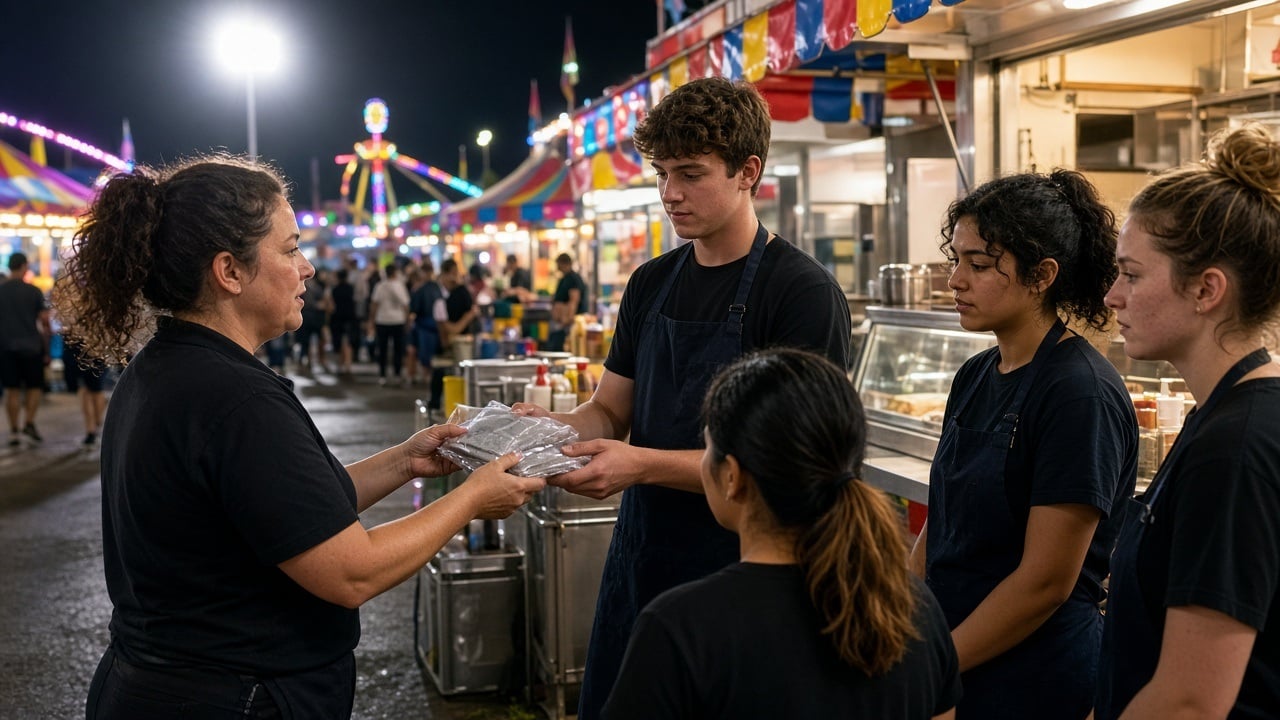
A service reduction affects orders already accepted, food in preparation, and visitors standing in line. Define who pauses new orders and how staff explain the change. Keep emergency and accessible routes clear while guests move. Do not shift a queue toward a location with worse conditions merely because it provides more shade or space.
Vendors need a safe, equipment-specific shutdown sequence and a plan for food that cannot be served as expected. Coordinate with environmental health when a disruption affects approved food-handling procedures. Staff should not remain in an exposure situation solely to protect revenue or finish every order. Agree in advance on the adjustment and refund authority for interrupted service. That keeps a public-health response from becoming a separate dispute at each counter, and it gives employees a practical way to implement the broader decision.
Reassess throughout the operating period
Conditions may improve and deteriorate more than once. Establish a reassessment schedule appropriate to the situation and a process for significant changes between scheduled checks. Review the same official sources consistently, document the time, and communicate changes through the agreed chain. Do not reopen a suspended activity solely because the sky looks clearer from one booth.
Separate the decision to resume from the mechanics of restarting. Confirm that staff have received the update, protective measures remain appropriate, and food-service equipment and holding procedures are ready. Tell guests what has changed without overstating certainty about the rest of the evening. The plan should allow management to modify operations again if needed. A reversible, clearly communicated service adjustment is easier to manage than an absolute promise that forces staff to defend a prediction they cannot control.
Practice a disagreement about the readings
A useful tabletop exercise begins with two supervisors reporting different AQI values. Ask them to identify the pollutant, observation time, location, and source. Then move through the actual decision chain: who checks the discrepancy, who consults health guidance, who decides, and who informs vendors and guests? Treat this as a hypothetical test, not evidence that a particular monitoring source is unreliable.
Include a vendor who has not received the radio message and a guest who needs information in another format. The exercise should expose gaps in communication and authority rather than become a quiz on atmospheric science. Record corrective actions with owners and deadlines. Check whether the people responsible for indoor spaces, worker controls, and order adjustments were included. If they learn about the plan only during the exercise, that is an opportunity to fix coordination before the next operating day.
Give the board a decision record it can understand
After a smoke-related change or drill, summarize the information used, the decisions made, and the operational follow-through. Do not claim that the absence of complaints proves nobody was affected. Ask whether messages were consistent, whether worker-protection responsibilities were understood, and whether guest options were actually available when announced. Keep personal medical information out of routine operational summaries.
For the next fair, carry forward specific improvements: a better monitoring assignment, a tested indoor space, clearer vendor contacts, or a more usable guest notice. Air quality is not something concession management can control, but confusion about who responds is manageable. A professional food-service plan connects the changing public-health information with practical action on the grounds, while leaving medical judgments and regulatory interpretation with the appropriate qualified professionals. Keep those assignments current as the operating crew changes. That is a defensible process, not a guarantee about the weather or anyone’s health.
Talk to FairFirst Before Your Next Fair
Professional concession management should connect the policy on paper with the decisions made on the grounds. FairFirst can help your team define responsibilities, coordinate vendors, and build practical operating procedures around your fair’s needs. Schedule a consultation with FairFirst to review your food-service operation and identify the next steps.
Start the conversation about your next fair.
Sources
- Air Quality Index Basics — AirNow, U.S. EPA (undated guidance)
- Event Ready — National Weather Service (undated planning guidance)
- Wildfire Smoke: A Guide for Public Health Officials — U.S. EPA and partner agencies (2019)
- Wildfire Smoke, Section 5141.1 — Cal/OSHA (2021 permanent standard)
- Effective Communication — U.S. DOJ (2020)


