


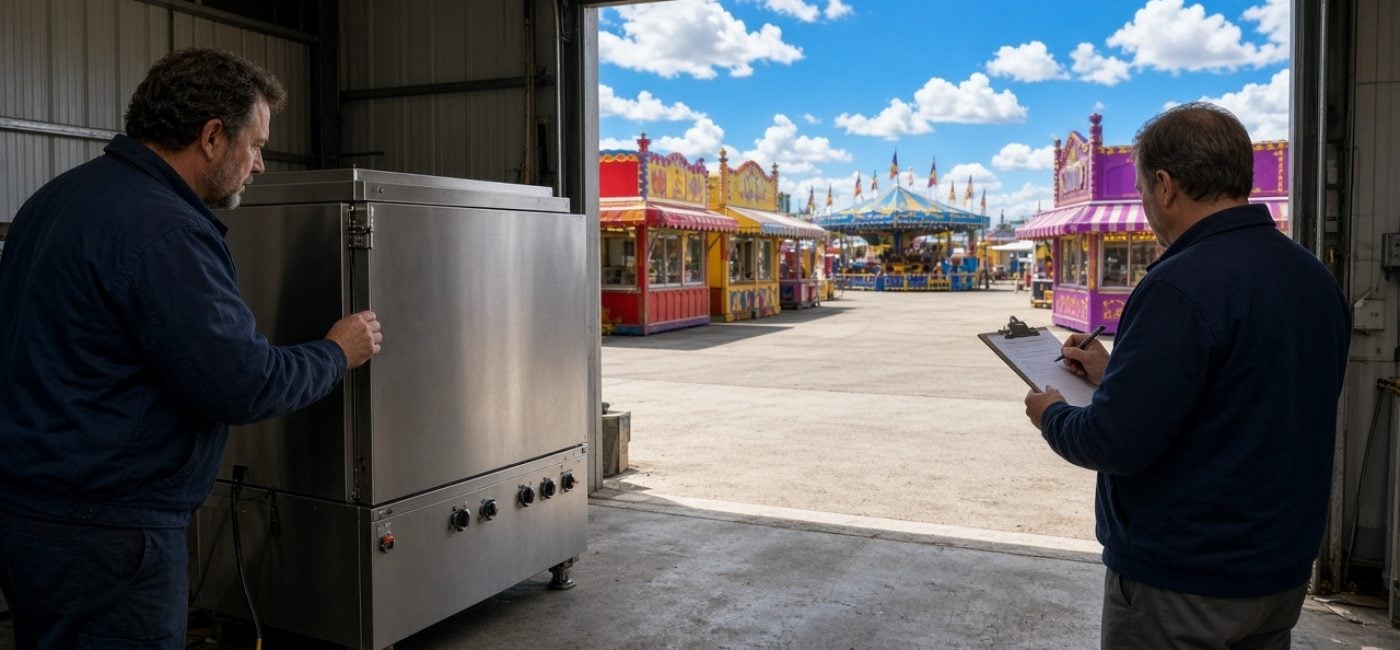
Storage does not resolve a known defect
A fryer with an unresolved fault can disappear into storage at the end of the season and return to the service lane with exactly the same problem. The calendar changed; the equipment did not. In this hypothetical example, nobody ignored a dramatic failure. The repair simply lost its owner between teardown, warehouse moves, and next season’s purchasing decisions. Fair concession equipment maintenance has to keep that ownership visible from teardown to the next opening.
December 31, 2025 is a useful point to decide which equipment is ready for storage, which needs qualified service, and which should be replaced before another event. The objective is not a generic reminder to be careful. It is a maintenance decision process tied to ownership, condition, manufacturer instructions, competent work, and release back into service. A clean exterior and a folded cover should never be treated as evidence that an unresolved operational issue has somehow gone away.
Identify the owner before assigning the work
List each significant food-service asset with a practical identifier, owner, location, model information, and responsible contact. Distinguish fair-owned equipment from vendor property, leased units, and items temporarily left on the grounds. A concession coordinator should not authorize work on somebody else’s asset without the appropriate agreement, and a vendor should not assume the fair will maintain equipment merely because it remains in a fair building.
The CDFA fairtime and interim rental agreement materials provide a useful reference for written responsibility in fairground use. The particular maintenance terms need to match the actual agreement and asset. Clarify who approves service, who pays, who holds records, and who can decide the unit is unavailable. If those answers differ, resolve them before storage. Otherwise, the next crew may find a machine that everyone recognizes but nobody is authorized to repair or replace.
Record the condition while the experience is fresh
Capture the operating issue before the crew disperses. Describe what staff observed, when it occurred, what work stopped, and what action was taken. Separate a confirmed diagnosis from a symptom. “Temperature fluctuated during service” is a useful observation; an unsupported claim that a particular component failed may send the technician in the wrong direction.
Use photographs where helpful for condition and identification, but do not treat a photograph as a technical inspection. Record missing parts, damaged surfaces, unusual operation, and unresolved service recommendations. Include normal maintenance due according to the manufacturer, not only emergency repairs. Give each open item an owner and next action. The asset record should make the unresolved status obvious to a person who did not work the fair. A machine that looks complete in a warehouse should not quietly lose the note explaining why it was removed from service.
Use the manufacturer’s instructions as the starting point
Find the correct manual for the model and configuration, and confirm service recommendations with the manufacturer or qualified provider when unclear. Do not substitute a similar-looking appliance’s instructions or a remembered cleaning routine. Different equipment can require different handling, maintenance, storage, and recommissioning steps. Keep the information where the people responsible for the asset can retrieve it.
The 2022 FDA Food Code provides a model framework for food-service equipment and maintenance, while applicable local requirements govern the actual operation. Equipment condition affects cleanability and food handling as well as whether the unit turns on. A repair that restores power may not address damaged food-contact surfaces or another unresolved condition. Have qualified personnel and environmental health review issues within their responsibilities. The maintenance plan should aim at suitable operation for the intended use, not merely a successful switch-on test.
Separate routine care from qualified fair concession equipment maintenance
Define what trained operating staff may do under the approved procedure and what requires a qualified technician. Cleaning, inspection, adjustment, electrical work, fuel-system work, and component replacement are not interchangeable tasks. Do not let the phrase “help with teardown” become permission for an employee to dismantle equipment they are not trained or authorized to service.
California’s Injury and Illness Prevention Program requirements address hazard identification, correction, communication, and training. Use the employer’s safety program to connect those responsibilities with equipment work. A person who notices a defect needs a clear report-and-stop route, not pressure to try an improvised fix so the unit can be packed. Qualified service should be planned and documented. The absence of customers during the off-season does not make maintenance hazards disappear, and a quiet storage building is not a reason to relax the procedures protecting the worker.
Control hazardous energy before service begins
Equipment can contain electrical, mechanical, thermal, fuel, or other hazardous energy. California’s Section 3314 hazardous-energy-control rule applies to covered cleaning, repair, servicing, setup, and adjustment where unexpected startup or release of stored energy could injure employees. The actual procedure must fit the equipment and work. This article is not a lockout instruction or authorization to perform a repair.
Have the employer’s qualified personnel establish and use the applicable process, including coordination with outside service providers. Do not reduce the issue to placing a handwritten note on a switch or assuming that an off position always provides adequate isolation. Exceptions and specific circumstances require competent review. Keep unauthorized people from restarting equipment under service and maintain the protection through personnel changes. The important management decision is to provide the right procedure and authorized workers before the repair is scheduled, not to ask the technician to solve missing controls on arrival.
Do not return a machine without its protective features
Missing guards, damaged controls, or improvised modifications need qualified assessment before equipment returns to use. The Cal/OSHA moving-parts guarding provisions address specified machinery hazards; additional equipment-specific and point-of-operation requirements may apply. Do not treat one general citation as a complete inspection checklist for every food appliance.
Staff should report a missing protective feature and follow the approved restriction on use rather than deciding that experience makes it unnecessary. A manager’s desire to finish a short service period is not a technical assessment. Include required parts and reassembly checks in the service scope and retain the work record. When the unit is released, the responsible person should be able to explain what was repaired, what was checked, and whether any limitation remains. “It worked last time” is not a suitable answer to a known condition that has not been resolved.
Prepare the storage environment, not only the appliance
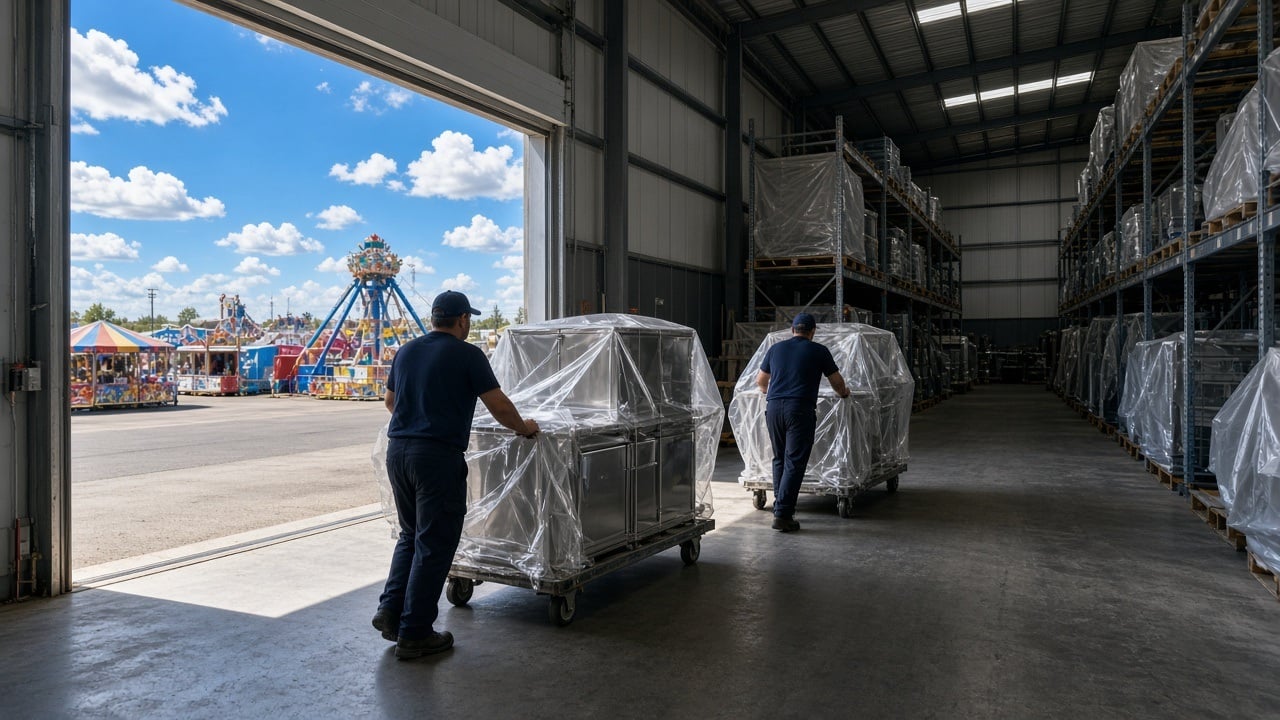
Review the manufacturer’s storage instructions and the conditions in the proposed location. Consider protection from contamination, pests, weather exposure, physical damage, and unauthorized use through the appropriate facilities and food-safety process. Keep equipment identifiable and accessible for planned inspection or service. Do not pack a unit so deeply that a scheduled repair becomes impractical until move-in week.
Plan movement with suitable equipment and trained personnel. Storage should not block emergency access or create a new material-handling hazard. Keep compatible components and the relevant records associated with the asset without leaving loose parts in food-contact areas. Avoid promising that one type of cover or one cleaning step is correct for every machine. The objective is a condition-preserving storage arrangement matched to the equipment, with clear status and a realistic path to the next required action.
Make repair-versus-replace a documented decision
Compare the qualified service assessment, expected availability of parts, suitability for the intended menu, operating history, and full replacement requirements. Include installation, utilities, approvals, training, and disposal where relevant. A low purchase price is not the whole cost of a replacement, and a small repair invoice is not the whole cost of keeping an unreliable or unsuitable unit.
Avoid inventing a universal age limit or return-on-investment formula. Some decisions require a technical or regulatory determination rather than a simple financial comparison. Show the board what is known, what remains uncertain, and the consequences of delaying the decision. If the asset must remain unavailable pending assessment, make that status explicit. Budgeting for a repair does not mean it has been completed. A replacement authorization should include the practical steps needed before the new equipment can legally and safely serve the menu.
Schedule recommissioning before the truck is loaded
Set a review point early enough to resolve problems before move-in. Confirm service completion, required documentation, installation needs, protective features, cleaning, and operating checks by appropriate personnel. Coordinate any inspection or approval required for the intended use. Do not treat the first lunch rush as the test of whether winter maintenance succeeded.
Keep a release record that identifies the asset, reviewer, date, work completed, and remaining restrictions if any. The process should distinguish “stored,” “service pending,” “under repair,” and “released for intended use.” Those are different conditions, even when the equipment sits in the same warehouse aisle. Give the loading crew current information so an unavailable unit is not selected simply because it is nearest the door. A good maintenance schedule ends with a confirmed readiness decision, not with a technician invoice filed somewhere nobody on the grounds can find.
Connect equipment choices with the next menu
Before returning an asset, ask whether it still fits the planned food operation. A menu change, altered location, or different production process may change capacity and utility needs. Have the vendor, concession coordinator, facilities team, and relevant authorities review those changes before assuming the old setup remains appropriate. Do not force the menu around an unsuitable machine simply because the fair already owns it.
Use the maintenance review to identify training and procedure updates. If controls or equipment change, staff may need new instruction before use. Keep manuals and contacts current for relief workers as well as the main operator. The replacement decision should account for the whole service chain, including cleaning and storage after the next event. Professional planning avoids treating equipment as a one-season purchase detached from the labor, infrastructure, and approved processes needed to operate it repeatedly.
Carry a short open-items list into the new year
The year-end deliverable should be concise enough to act on: asset, condition, responsible owner, approved next step, budget status, deadline, and release requirement. Review it with the people who can authorize work and the people who will use the equipment. Do not hide unresolved items inside a broad statement that everything is in storage and ready for next season.
Check progress at defined points before the event rather than waiting for a loading-day surprise. Keep the discussion factual and avoid blaming a vendor or worker for a defect that has not been assessed. The fair needs decisions and follow-through. Professional concession management helps connect those maintenance responsibilities with menu planning, facilities work, and vendor readiness. Storage is a pause in use, not a repair method. The equipment should enter the next season because somebody confirmed it is ready, not because nobody remembered why it was put away.
Talk to FairFirst Before Your Next Fair
Professional concession management should connect the policy on paper with the decisions made on the grounds. FairFirst can help your team define responsibilities, coordinate vendors, and build practical operating procedures around your fair’s needs. Schedule a consultation with FairFirst to review your food-service operation and identify the next steps.
Start the conversation about your next fair.
Sources
- Fairtime and Interim Event Rental Agreement — CDFA (2019)
- 2022 Food Code — U.S. FDA (2022)
- Injury and Illness Prevention Program, Section 3203 — Cal/OSHA (regulation through 2020)
- Control of Hazardous Energy, Section 3314 — Cal/OSHA (regulation applicable 2025)
- Machine Guards, Section 4002 — Cal/OSHA (regulation applicable 2025)


