


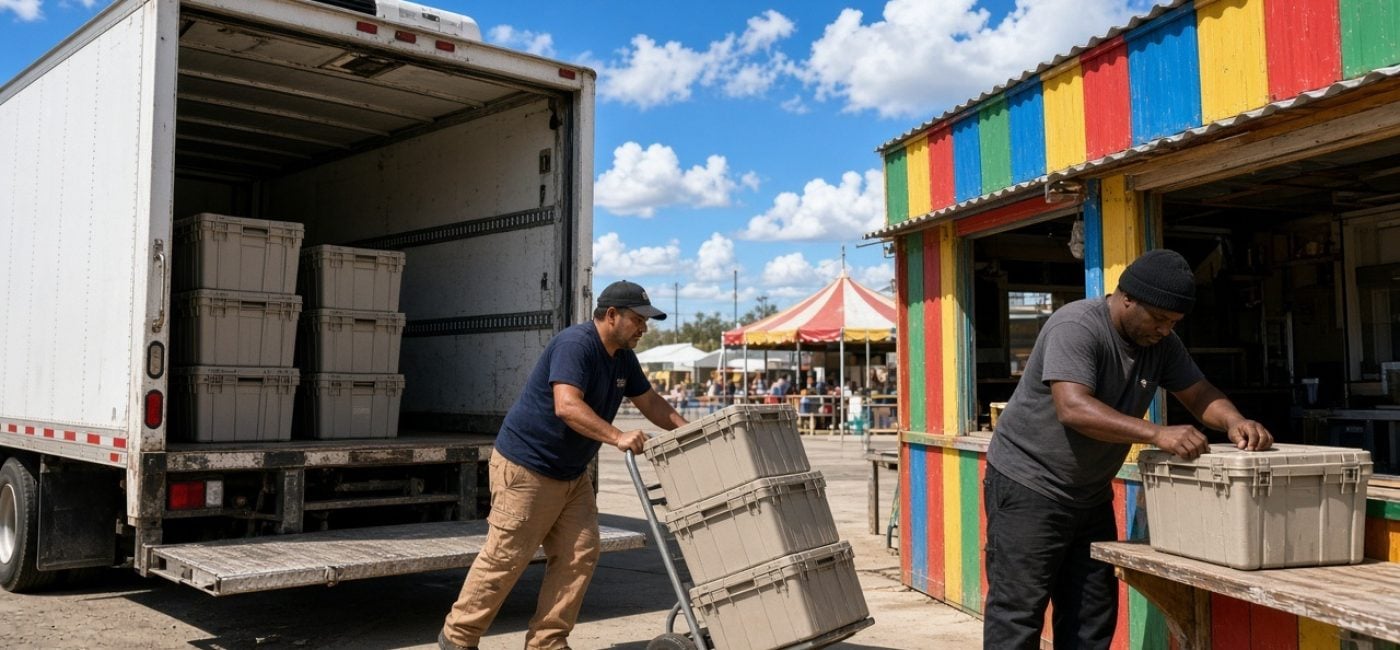
Day three can reveal the inventory plan nobody actually had. A popular item sells faster than expected, backup stock is still at a distributor, and the remaining product is stored in the wrong place. Guests see an unavailable menu item. The fair sees a short selling window disappearing. Practical fair concession inventory management is how that third day stays uneventful.
Consider the phrase “we lost $87,000 because one vendor ran out.” That is an illustrative scenario in this article, not a verified quotation, customer story, or documented loss at a named fair. The useful question is how such exposure can develop, how to calculate it honestly, and which operating controls can keep a stock problem from becoming an event-wide scramble.
Midseason is the time to examine those controls while there are still service days ahead. Inventory is not just a purchasing task. It connects forecasting, receiving, refrigeration, preparation, replenishment, supplier communication, and the person authorized to make a decision before a booth runs dry.
Build the $87,000 example from visible assumptions
Imagine one high-volume concession loses access to a core product on day three and cannot restore its normal menu for three busy days. Assume 200 otherwise achievable transactions per hour, ten affected selling hours daily, and an average $14.50 transaction.
- 200 transactions × 10 hours = 2,000 potential transactions daily.
- 2,000 × 3 days = 6,000 potential transactions.
- 6,000 × $14.50 = $87,000 in exposed gross sales.
This is not a claim that the entire amount inevitably disappears. Customers may buy substitutes at the same booth, move to another concession, or return later. If half the modeled spending is retained elsewhere on the grounds, the event-wide gross-sales gap would be $43,500. The original booth’s financial result could differ.
It is also not net profit or automatically the fair’s commission loss. At an illustrative 20% commission, $87,000 in unrecovered gross sales would correspond to $17,400 in commission, before contract-specific treatment. Do not add commission to gross sales and call the sum a separate economic loss.
Use your own transactions, prices, contribution margins, and substitution observations to test exposure. A transparent smaller estimate is more useful than a dramatic number that cannot survive a board member’s first question.
National food supply is context, not your order sheet
The USDA Economic Research Service Food Availability Data System provides national food-supply measures and consumption proxies across many commodities. Its loss-adjusted series accounts for estimated spoilage and other losses. These measures are useful background, but they do not tell a fair how many cases of a particular product will arrive tomorrow.
Do not use national per-capita availability as a booth demand forecast or proof of a local 2026 shortage. Ask suppliers about the actual product, specification, allocation, lead time, delivery schedule, and acceptable alternatives. A broad commodity category can look stable while one package size is temporarily unavailable.
Keep dated supplier confirmations separate from assumptions. “Usually available” and “allocated for Tuesday delivery” are different levels of confidence. Management should know which critical items have a confirmed replenishment route and which rely on hope.
Forecast portions, then translate them into stock
Start with expected transactions by menu item and service window. Account for concert timing, weather scenarios, discounts, and differences between weekdays and weekends. Review actual early-event sales daily rather than defending a preseason spreadsheet after demand has changed.
Convert servings into ingredients using a consistent recipe and realistic yield. Include packaging, cups, lids, cooking inputs, and any other item that can stop service. A full freezer is not useful if the booth runs out of the container required to hand the product to a guest.
Distinguish stock on hand from stock usable for the next service window. Product can be physically present but frozen when thawed supply is needed, reserved for another booth, awaiting a safety decision, or incompatible with the menu. Count available-to-use portions, not just cartons.
Use reorder points with an owner attached
For each critical item, define expected demand during replenishment lead time plus a safety buffer appropriate to demand uncertainty and storage capacity. That is a planning method, not a universal formula producing the same buffer for every fair.
In a simple example, a booth expects to use 300 portions before its next reliable delivery and chooses a 100-portion buffer. Its reorder trigger is 400 usable portions. If the supplier requires another day’s notice, the trigger must reflect that longer lead time. A fixed number becomes unsafe when its assumptions change.
Assign the person who counts, the person who orders, and the person who confirms arrival. Set a deadline for escalation when a count is missing or a supplier cannot commit. A dashboard without action authority can display a stockout perfectly while doing nothing to prevent it.
Cold chain first, inventory value second
The FDA Food Code 2022 generally uses 41°F or below for cold holding and 135°F or above for hot holding of time/temperature-control-for-safety food, subject to specific provisions. It is a model code; California law and local approval determine the fair’s operating requirements.
The California temporary-food-facility rules require suitable temperature-control equipment during transportation, storage, and operation. They also contain limited temporary holding allowances and end-of-day destruction requirements. Do not assume restaurant leftovers or marginally cooled product can automatically be carried into tomorrow’s fair service.
USDA FSIS consumer guidance recommends keeping cold food at or below 40°F and hot food at or above 140°F. Those conservative consumer recommendations are not the same as the retail code’s general holding thresholds. Use the correct standard for your approved process instead of mixing numbers casually in staff instructions.
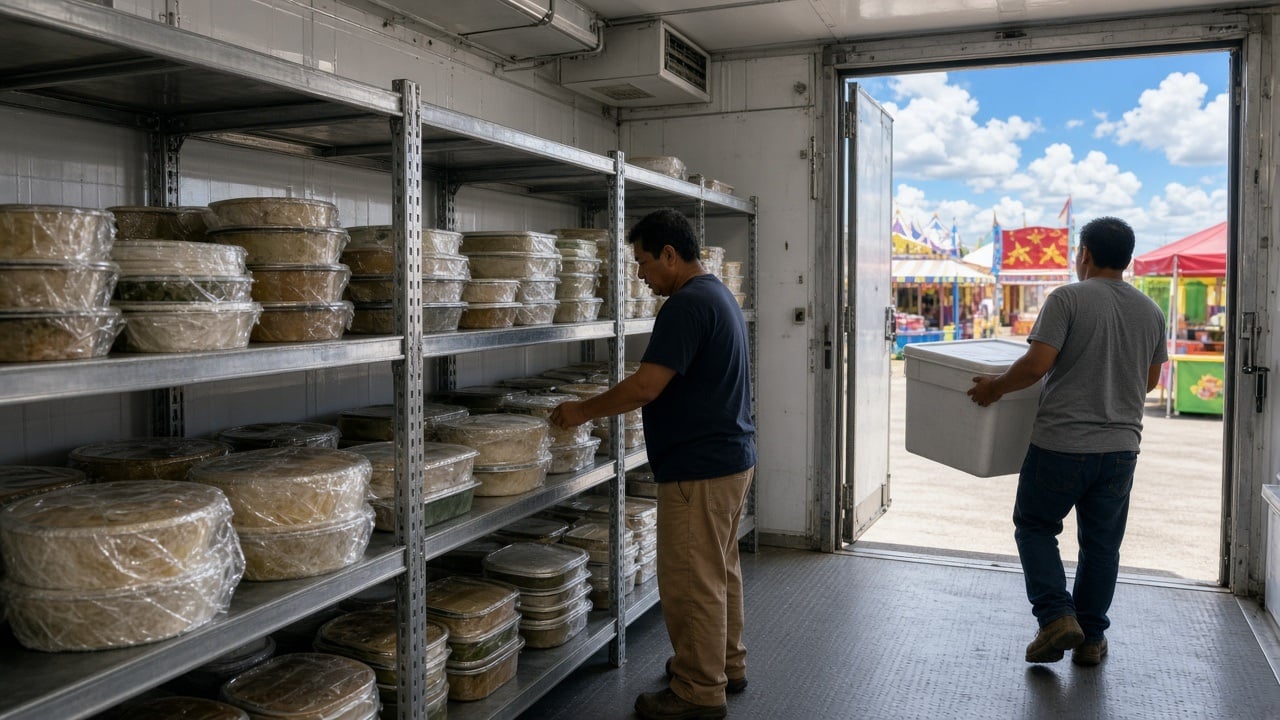
Record receiving temperatures and inspect condition, packaging, and source information as appropriate. Reject or isolate product that does not meet the approved acceptance criteria. Saving a purchase order is not a reason to accept questionable food, and a truck’s air reading alone is not a complete account of product condition.
Do not over-order your way into spoilage
A large opening order can reduce one delivery risk while creating another: overloaded storage, blocked airflow, hard-to-access stock, and more product than the operation can safely use. Match orders to verified storage and handling capacity rather than treating every empty corner as approved space.
Rotate usable stock by appropriate dates and handling requirements. Keep identification and source information intact. Track opened, prepared, held, and discarded product separately where needed. A single “remaining inventory” total hides the difference between safe unopened supply and food requiring disposition.
Plan smaller preparation batches where the menu and approved process allow it. More purchasing does not justify preparing everything early. Work with the local authority on permissible cooling, storage, hot holding, and end-of-day disposal. The right objective is safe saleable inventory, not the smallest visible waste number.
Real-time tracking means timely decisions
You do not need to begin with a complicated system. Start with one shared record containing item, unit, location, usable quantity, count time, expected consumption, incoming delivery, and responsible person. Use the same units everywhere; cases, pounds, and portions cannot be compared without conversion.
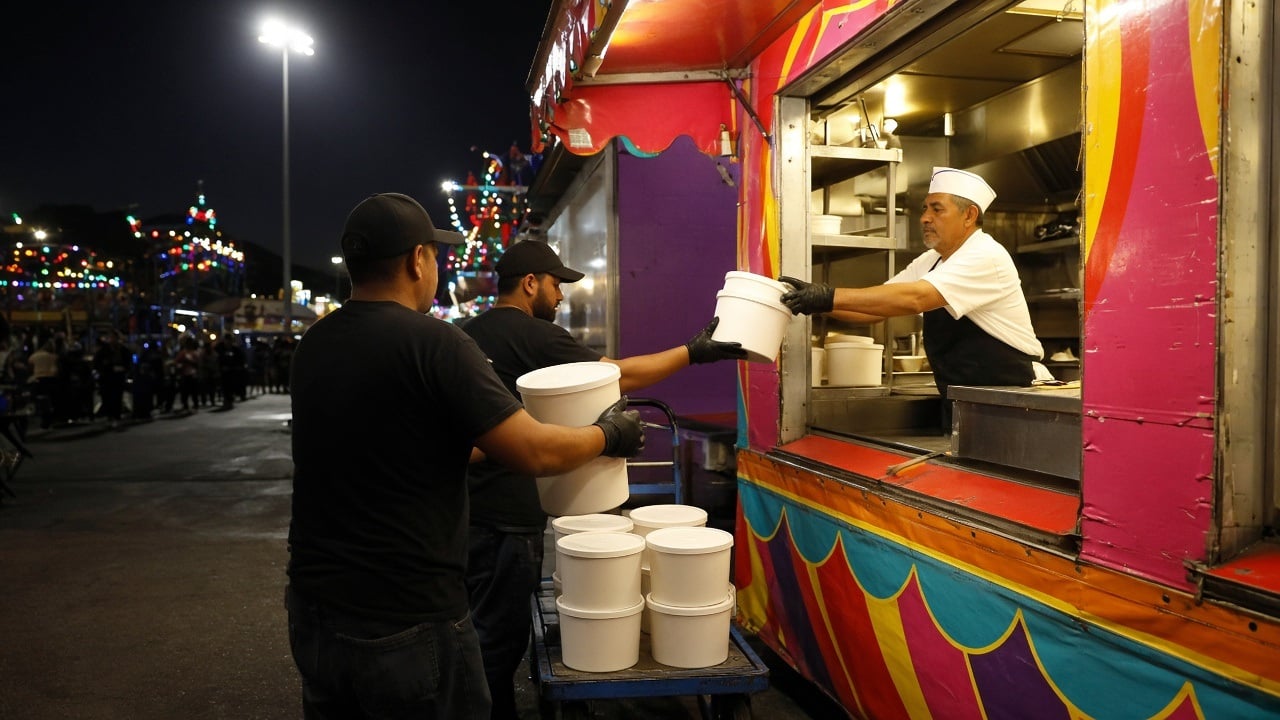
Make the update interval match the risk. A fast-selling item near its reorder point may need more frequent checks than sealed backup packaging. Train staff to record transfers between booths and waste as they occur. Otherwise the central record becomes less trustworthy with every emergency run.
Reconcile physical counts against sales and expected recipe use. Differences can reflect portion variation, waste, transfers, counting mistakes, or recipe assumptions; do not jump immediately to an accusation. Investigate with the booth lead and correct the process before the discrepancy compounds.
Have a substitution plan before you need one
List acceptable backup suppliers and product specifications before opening. Review food-safety and permit implications of any replacement. A substitute that fits the price but changes preparation requirements is not automatically operationally equivalent.
Check allergens every time the ingredient changes. The FDA’s sesame guidance specifically warns that familiar products may have changed recipes and recommends checking labels. Keep updated information available to the people answering guests’ questions. Never rely solely on what last week’s package contained.
If a safe replacement is unavailable, communicate the limitation honestly and redirect guests to available choices. Update the actual service offer before customers spend time waiting for something the booth cannot sell. A manageable menu reduction is better than a rushed, unreviewed workaround.
Connect the supply route to fair operations
Delivery windows, gate access, vehicle routes, refrigeration power, and receiving labor all belong in the concession plan. A supplier arriving on time is not enough if nobody can receive the product or the truck cannot reach the approved unloading area.
Hold a short daily inventory review with concession management and the fair’s relevant operations lead. Identify the next critical delivery, items nearing triggers, refrigeration concerns, and supplier exceptions. End with assignments and confirmation times, not a general promise to monitor inventory.
At close, reconcile sales, usable remaining product, documented waste, and the next day’s production plan. Keep financial loss estimates separate from discarded inventory cost. One is a forecast of missed opportunity; the other is a recorded product expense. Combining them without explanation inflates the story.
Test your fair concession inventory management with a day-three exercise
Before the next busy weekend, pick the menu item with the fewest substitutes and simulate its loss. Assume the primary delivery misses the approved receiving window. Ask how much safe usable stock remains, which verified alternate can supply it, and who can authorize the order without waiting for the next board meeting.
Include refrigeration failure in a separate exercise. Identify approved backup space, a safe transfer route, temperature checks, and the person responsible for disposition decisions. Keep food awaiting evaluation clearly controlled so a hurried worker does not mistake it for available supply. These exercises should improve the plan, not justify serving food whose safety is uncertain.
After the event, retain the forecast assumptions and the corrections made during service. Next season’s best starting point is a record explaining what sold, what was wasted, what arrived late, and why the original plan changed.
Give leadership a concise account of the changes that would protect the next event: additional approved cold storage, different delivery timing, a simpler recipe, or a designated receiving position. Prioritize the items that constrain service rather than spreading attention equally across every supply. A practical inventory review should end with a purchasing decision, an operating change, or a clearly assigned follow-up. Otherwise the same uncertainty will return on day three, regardless of how detailed the spreadsheet looks.
Talk to FairFirst Before Your Next Fair
Professional concessions operations connect purchasing with the realities of the fairground. FairFirst can discuss the forecasting, receiving, stock visibility, and daily supervision needed to protect your short selling window without compromising food safety.
Sources
- Food Availability (Per Capita) Data System — USDA ERS, 2025
- Food Code 2022 — FDA, 2022 (2024 supplement)
- California Retail Food Code, including Chapter 11 — CDPH, effective January 2026; Alameda County copy
- Danger Zone (40°F–140°F) — USDA FSIS, 2023
- The FASTER Act: Sesame Is the Ninth Major Food Allergen — FDA, 2023


