


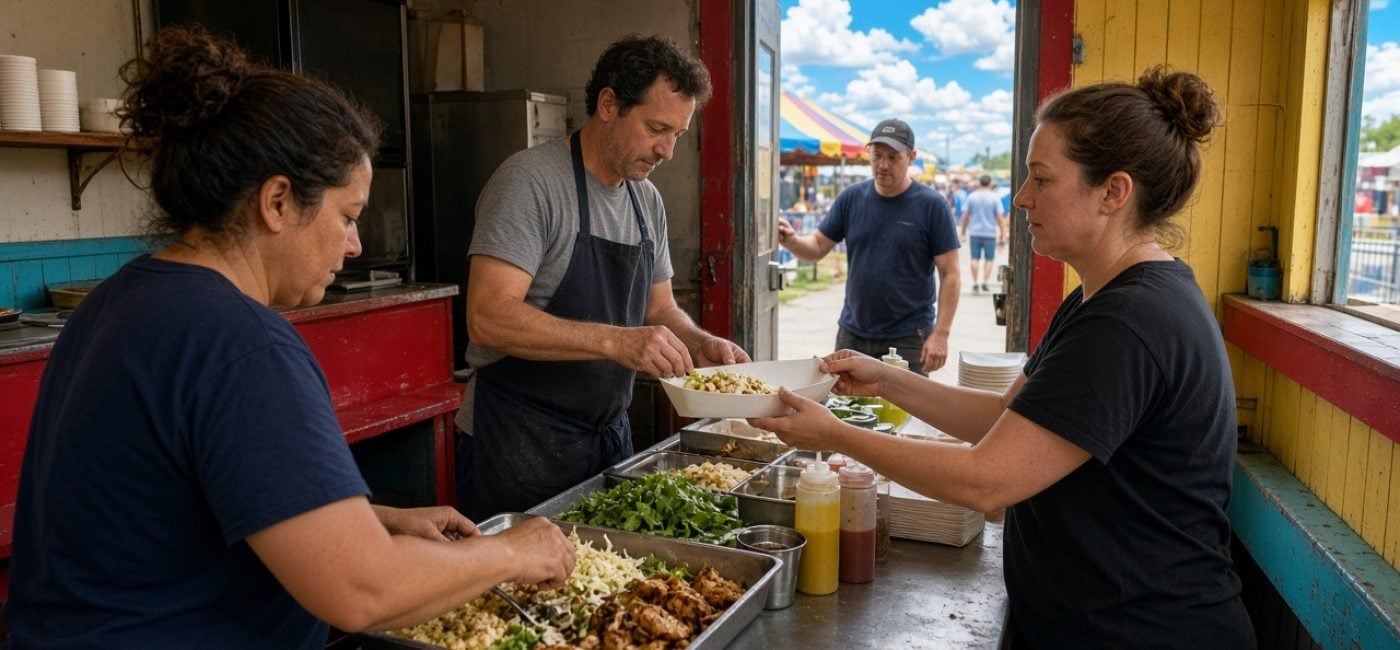
The staffing plan looks complete on Friday afternoon. Then Saturday arrives: two cooks cannot make it, a cashier is stuck outside the wrong gate, and the person assigned to relieve the grill team has never worked that station. Forty booths can turn a handful of absences into an event-wide service problem. Reliable fair concession staffing plans for that Saturday before it arrives.
The $50,000-plus figure in this headline is an illustrative weekend sales calculation, not a documented loss at a named fair. The point is to make missing capacity visible before summer opening. A no-show is not simply an unpaid shift. It can reduce the sales capacity of everyone who did arrive.
For fair boards reviewing staffing this May, the useful question is not “How many people have you hired?” Ask how many qualified people will be physically in position at each important hour, including when employees take meals, rest, and heat-protection breaks.
The labor market does not stop at your gate
The Bureau of Labor Statistics March 2026 JOLTS release, published May 5, reported a preliminary 831,000 job openings in accommodation and food services nationwide. The same release reported 889,000 hires and 818,000 total separations in that industry for March. Those are national monthly measures, not California fair no-show rates.
They still provide useful context: fairs recruit into an industry with substantial movement between jobs. An accepted offer does not guarantee an employee can reconcile another schedule, transportation, childcare, and a late fair closing. Management needs to confirm those practical arrangements rather than treating acceptance as the final staffing milestone.
Nor should managers assume that every absence reflects indifference. A confusing gate instruction or an unexpected parking charge can undermine the first shift. Clear communication and workable employment conditions deserve attention before anyone blames the labor market.
Show the $50,000 math honestly
Consider a fictional 40-booth fair. Assume ten busy booths are each short enough trained labor to lose 20 completed transactions per hour during six peak hours on both Saturday and Sunday. Assume an average transaction value of $22.
- 10 affected booths × 20 missed transactions = 200 missed transactions per hour.
- 200 × 6 peak hours × 2 days = 2,400 transactions.
- 2,400 × $22 = $52,800 in potential gross concession sales.
Every input is an assumption. This is not $52,800 of net profit, and it is not automatically the fair’s commission loss. Some guests may buy from another booth instead. Others may purchase later, spend less, or leave the food area. If 25% of those hypothetical sales move elsewhere on the grounds, the modeled net sales gap falls to $39,600.
At an illustrative 20% commission rate, a $52,800 gross gap would mean $10,560 in commission before considering any recovery or contract differences. Keep those categories separate. Calling every missed vendor dollar a lost fair dollar makes the board’s decision less accurate, not more urgent.
Replace these assumptions with your own service observations, transaction values, and guest-flow patterns. Count completed orders during comparable periods, note queue abandonment carefully, and record which roles are missing. The calculation should help compare the cost of extra coverage with plausible avoided disruption.
Budget a legal shift, not an imaginary cheap one
California’s statewide minimum wage became $16.90 per hour on January 1, 2026. Higher local or applicable industry rates may govern a particular operation. Verify the fair’s location, employer, and coverage rather than assuming that one statewide number answers every payroll question.
Under the Labor Commissioner’s general overtime rules, covered nonexempt employees generally receive time-and-a-half after eight hours through twelve hours in a workday and double time after twelve. Weekly and seventh-consecutive-day rules also matter, as do applicable exceptions. A twelve-hour fair operating day is not a reason to ignore daily overtime.
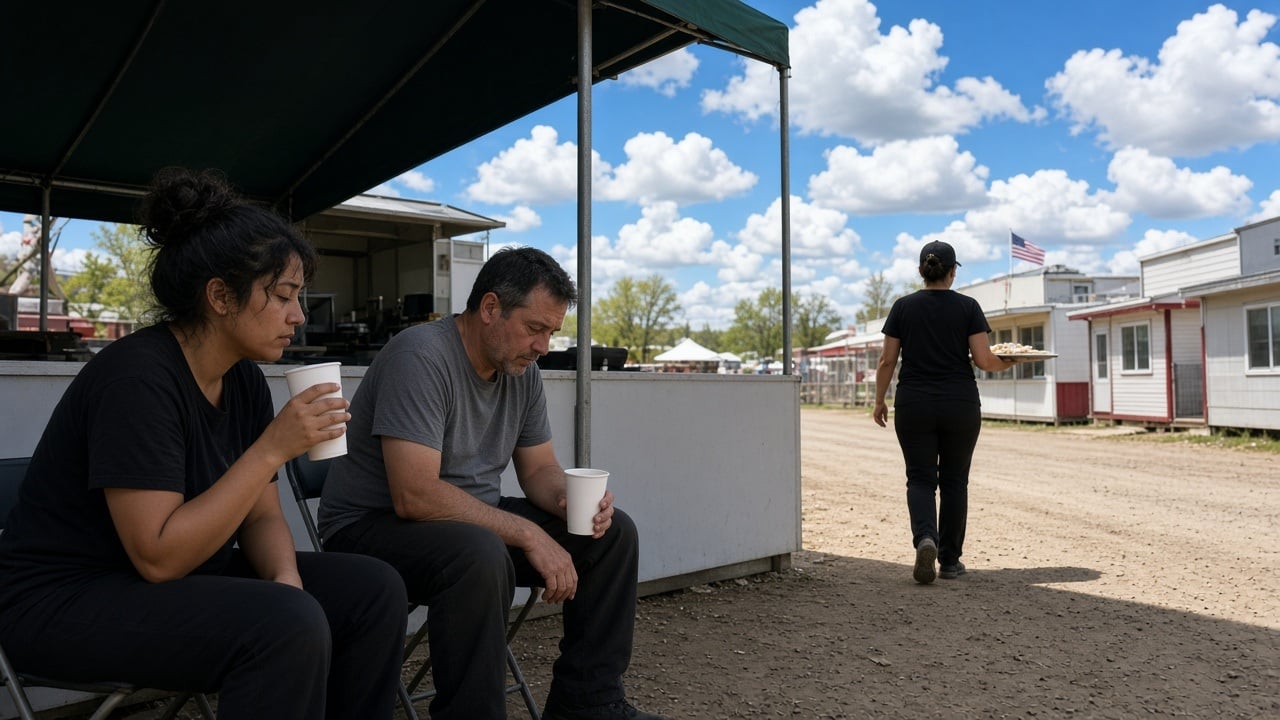
For a simplified example, assume an adult nonexempt worker’s regular rate is exactly $16.90, no special exception applies, and the person works twelve compensable hours. Eight hours at $16.90 equals $135.20. Four hours at $25.35 equals $101.40. The total is $236.60 before payroll taxes, insurance, benefits, or other costs. Actual regular-rate calculations may include additional compensation.
That example is payroll math, not a recommended schedule. A worker’s presence across a twelve-hour span may include unpaid lawful meal time, while paid rest time remains compensable. Build the actual schedule and have payroll or qualified counsel confirm the rules that apply.
Build fair concession staffing around roles and relief, not names
Create a station map for every booth: cooking, assembly, cashiering, food running, receiving, sanitation, and supervision. Mark the qualifications needed and the hours of demand. Three available cashiers do not replace a missing trained cook if nobody can safely run the equipment.
Next, add relief requirements. The California meal-period FAQ explains the general meal requirements for covered employees, including a first meal for work periods over five hours and a second for work periods over ten, with limited waiver conditions. The rest-period FAQ describes paid rest periods based on hours worked. Do not use the existence of a rush as the operating plan for missing breaks.
A float worker is useful only if that person is actually available. If the same employee is scheduled to cover a meal, receive a delivery, and replace a no-show simultaneously, the plan contains a hidden vacancy. Show overlapping assignments on a single timeline and remove the conflicts before opening.
Make arrival boring and predictable
Send each worker one clear set of instructions: reporting time, entry gate, parking arrangement, contact person, clothing, assigned station, and expected shift end. Explain how to report a delay or illness. Confirm receipt far enough ahead to correct misunderstandings.
Run paid training and onboarding in a way that meets applicable wage rules. Do not expect people to learn a station through unpaid trial work or to clock in only after management finishes required preparation. The employer needs accurate timekeeping for work it requires or permits.
Set a staffing readiness checkpoint before the gate rush. The lead should verify who is present and qualified, which relief assignments are covered, and which absences need escalation. A roster with colored boxes is not proof that the workers have reached their stations.
Heat is part of the staffing equation
Cal/OSHA’s heat resources distinguish indoor and outdoor requirements. A concession operation may need to assess both, depending on the work areas. A hot trailer kitchen cannot be treated as safe simply because the public walkway outside feels comfortable.
Plan water access, shade or appropriate cool-down space, training, emergency response, and observation of workers adapting to heat. Confirm the requirements for each location and task. When someone needs a preventative cool-down rest, coverage should already exist; employees should not have to negotiate with a line of impatient guests.
Teach supervisors the escalation route for heat symptoms and how to summon medical help. Do not build a reserve list that depends on inexperienced replacements immediately tolerating the hottest station for an entire shift. Training and acclimatization are part of readiness.
A reserve team must be real capacity
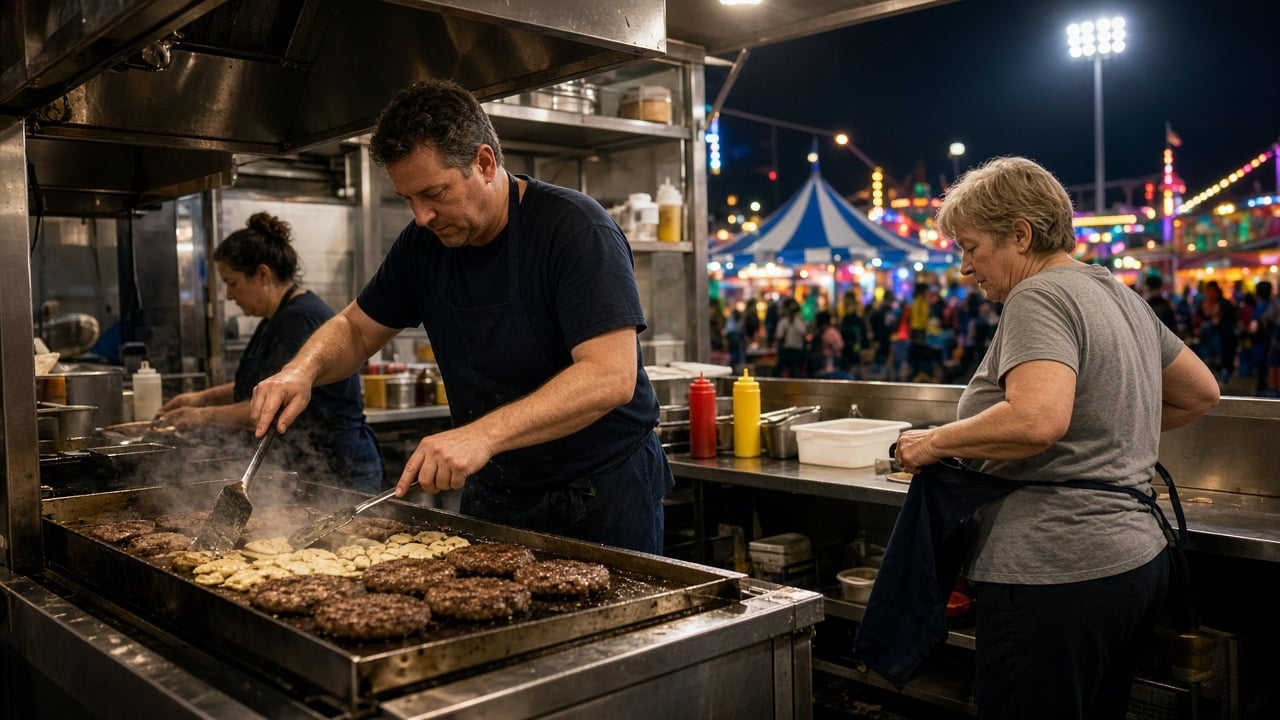
Build a paid, properly scheduled relief strategy with defined skills, reporting arrangements, and a lead who can deploy people. Review any on-call, reporting-time, or standby obligations with qualified payroll advice. “We have people we can text” is not the same as a trained replacement arriving when needed.
Cross-train before the event. A cashier can learn an assembly role during a planned session; a dinner rush is a poor place to discover that the replacement does not know ingredient handling or the handwashing process. Document demonstrated competence rather than only training attendance.
Establish a fallback service plan for genuine shortages. Simplifying a menu or temporarily closing one window may be safer and more honest than pretending a full service model still exists. Communicate changes to guests and fair leadership promptly, with a realistic recovery estimate.
Retention is an operating decision
UNITE HERE’s food-service industry overview highlights the workers behind food service across institutional and hospitality settings. It is a useful reminder to include the worker perspective, not a source of a fair-specific staffing benchmark or a guarantee that one employment arrangement solves attendance.
Ask employees what makes the assignment workable: clear pay information, dependable schedules, respectful supervision, accessible breaks, safe equipment, and a way to raise concerns. Where a collective bargaining agreement applies, coordinate staffing and work assignments with its requirements and worker representatives.
A manager who repeatedly solves absences by extending the same reliable workers’ days may create the next shortage. Track the burden on individuals, not just total labor dollars. Invite feedback after the first weekend while there is still time to change the remaining schedule.
Give the board a staffing dashboard that matters
Report scheduled versus present workers by role, unresolved vacancies, time to relief, actual overtime, and documented service interruptions. Add meal and rest coverage exceptions and heat-related operational issues. Keep personal medical information out of routine board summaries.
Compare labor cost with completed service, not simply with last year’s headcount. A slightly larger qualified crew may support more consistent throughput, but that should be tested against actual results. Do not promise a fixed revenue lift from adding workers without a baseline.
At the end of each peak day, assign owners to recurring problems. If employees are late because entry instructions are wrong, correct the instructions. If one station cannot keep up despite full attendance, examine layout, menu complexity, or equipment rather than recruiting endlessly for a process problem.
Rehearse a bad Saturday before it happens
Use a tabletop exercise with the concession leads. Remove one experienced cook, delay a delivery, and add a concert-release surge to the same hour. Ask who moves, who stays, how breaks remain covered, and which menu adjustments are authorized. Put names and times against the response. If the exercise works only because one supervisor does four jobs at once, it has revealed a gap worth fixing.
Then test the communication chain with the actual tools staff will carry. A replacement needs the right booth location and a person ready to receive them, not a vague instruction to find the busiest stand. Keep a simple record of the changes made after the rehearsal so next season’s staffing plan inherits the lesson.
Finally, decide how the fair will judge success beyond attendance. Reliable coverage should mean safe work, lawful breaks, consistent food handling, and a guest line that the available crew can actually serve. Those outcomes are more useful than a claim that every vacancy was technically filled.
Talk to FairFirst Before Your Next Fair
Reliable concessions staffing connects recruiting, realistic payroll, trained station coverage, relief, and active on-site supervision. FairFirst can help your team examine that complete operating picture instead of discovering gaps at the busiest hour.
Sources
- JOLTS: March 2026 Results — Bureau of Labor Statistics, May 5, 2026
- California Minimum Wage Increase for 2026 — DIR, 2025
- Overtime FAQ — California Labor Commissioner, undated
- Meal Periods FAQ — California Labor Commissioner, undated
- Rest Periods FAQ — California Labor Commissioner, undated
- Heat Illness Prevention — Cal/OSHA, undated
- Food Service — UNITE HERE, undated


