


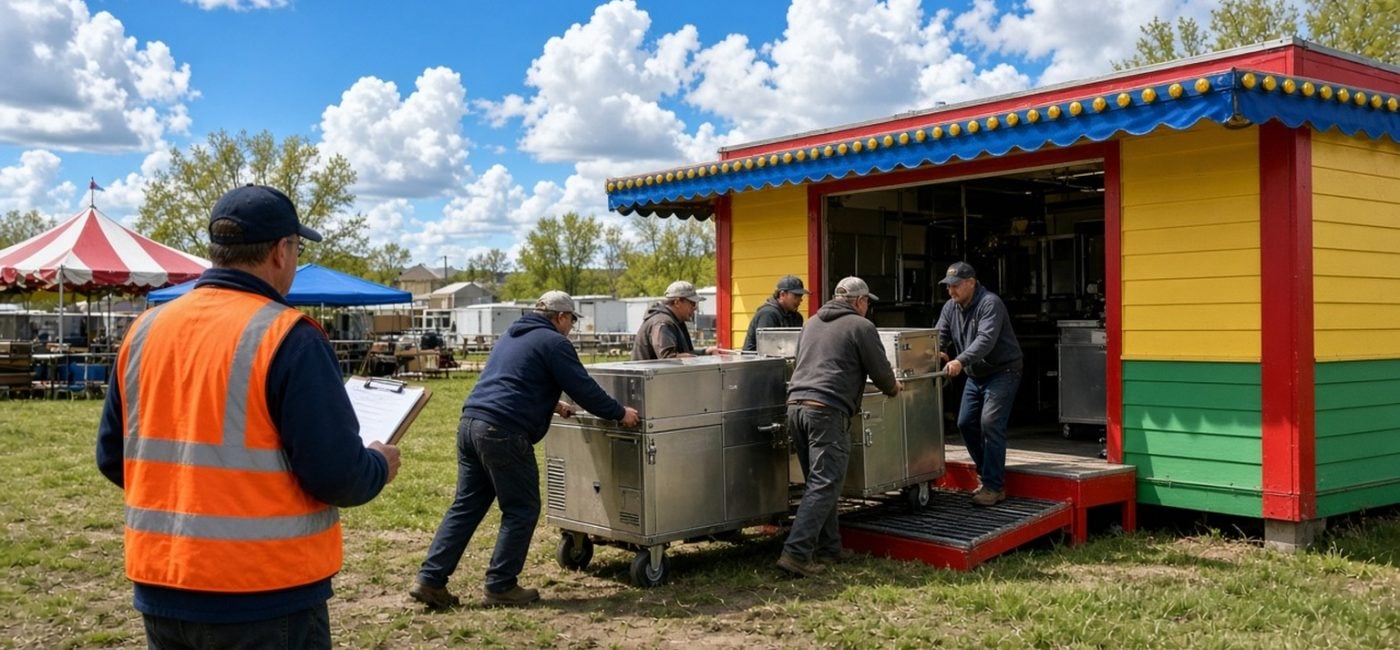
One vendor needs more power. Another has not delivered its insurance documents. A refrigerated delivery is waiting at the wrong gate, and the person checking credentials is also fielding questions about commission payments. The fair opens soon. Every loose end suddenly belongs to the same exhausted office. Good fair concessions logistics give each of those loose ends an owner and a deadline long before opening day.
The ten-day squeeze in this headline is an illustrative planning scenario, not a recommended application window or a measured industry average. There is no evidence here that most fairs share an identical timeline. The point is practical: when applications, approvals, move-in, operations, settlement, and teardown collapse into one short burst, ordinary administrative gaps become operating problems.
Late August is a useful time to examine that squeeze, whether your 2026 fair is approaching or already finished. A dedicated concessions-management team cannot manufacture extra days. It can establish an order of work, identify missing prerequisites, and keep one unresolved issue from disrupting the whole food program.
Separate the fair’s public calendar from its work calendar
Guests see opening day and closing night. Concessions teams need an earlier calendar for recruitment, selection, contracts, permits, utility coordination, training, and reporting setup. Teardown is not the finish line either. Final settlement, damage review, records retention, and lessons learned continue after the last truck departs.
Build backward from each hard deadline. Identify which tasks depend on another party’s approval. A menu decision affects equipment, power, food preparation, and the health-permit application. A booth relocation affects access and the site plan. Those dependencies should be visible before management promises a space to a vendor.
The schedule should name an owner, a due date, the evidence needed for completion, and the consequence of a missed milestone. “In progress” is not enough. A vendor with an unsigned contract is not equivalent to one whose approved agreement is already filed.
Use application intake to expose operating requirements
A strong application is more than contact information and a menu photo. Ask for the actual business entity, stand dimensions, proposed equipment, utility demand, food preparation arrangements, vehicle access, and operating contacts. Collect the information in consistent fields so the site team is not interpreting dozens of unrelated attachments.
Keep acceptance conditional where approvals remain outstanding. Make clear that selection by the fair does not replace a health permit or other required authorization. Do not ask the vendor to guess which document the office needs next. Send one checklist showing submitted, incomplete, approved, and expired items.
Alameda County’s community-event guidance, for example, identifies permits for both event sponsors and temporary food facilities. It also distinguishes mobile food facilities from temporary food facilities. That illustrates why intake must classify the operation correctly rather than treat every truck, booth, and trailer as interchangeable.
Permits are dependencies, not opening-day errands
Work directly with the authority for the event’s location to confirm application deadlines, plan requirements, and inspection arrangements. Do this before publishing your internal vendor deadlines. County processes differ, and a short sales season does not exempt a food operation from review.
The California Department of Tax and Fee Administration’s temporary-seller guidance explains temporary-location registration and the distinction between a temporary permit and a sub-permit for an existing permanent business. It also describes separate reporting for sales on state-designated fairgrounds. Assign someone to collect the required vendor information rather than discover missing registration at checkout.
The practical lesson is not to compress regulatory work into ten days. It is to start it early enough that the final operating window can focus on execution. Professional management should challenge an unrealistic timeline, not congratulate itself for accepting one.
Create one controlled site plan
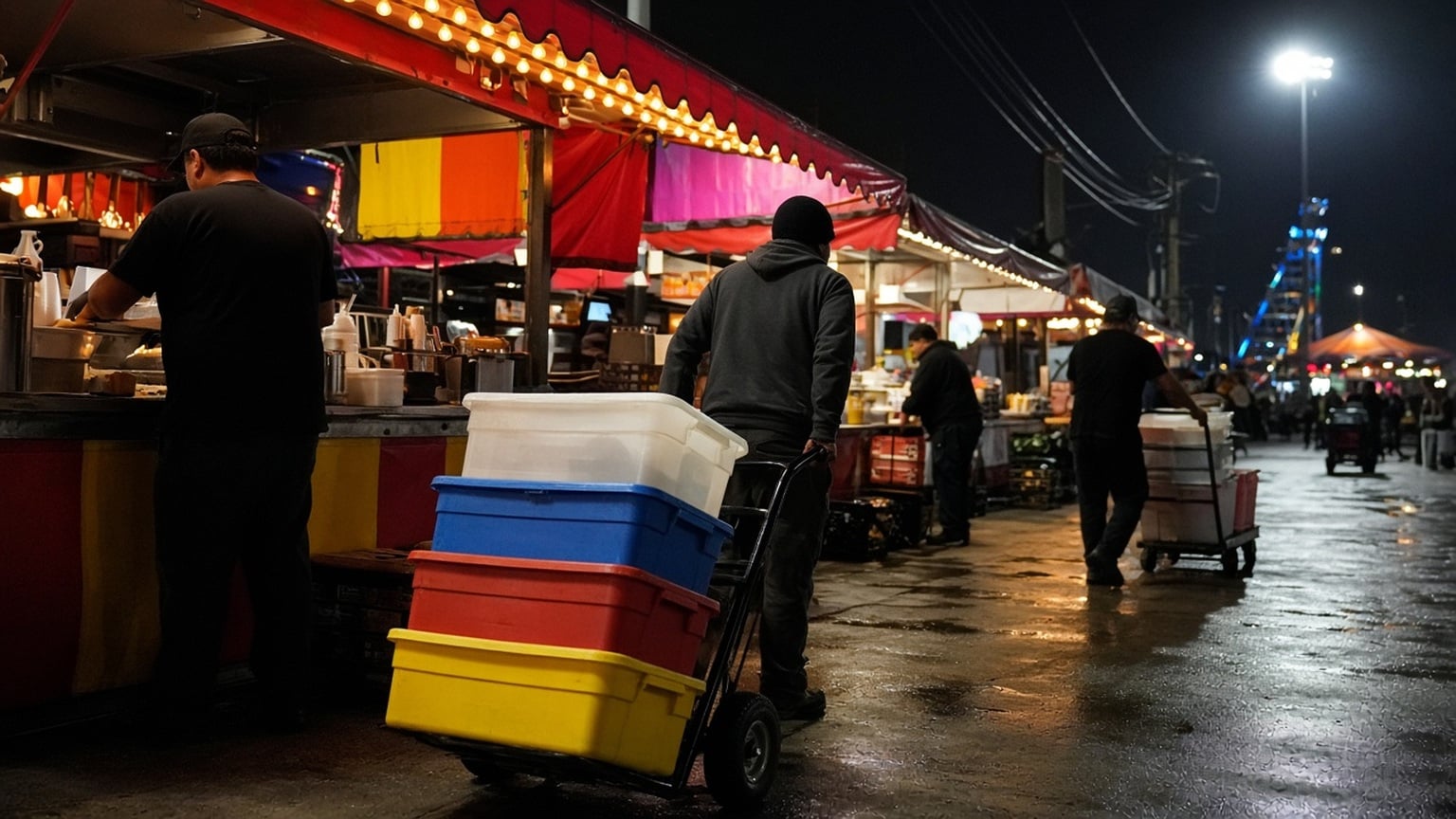
The food program needs a shared map showing approved stand locations, service routes, water, wastewater, waste collection, storage, and emergency access. Utility and public-safety teams should work from the same version. A changed location should trigger a documented review of the requirements that move with it.
A stand that fits on a diagram can still create a blocked delivery route or a poor queue. Walk the grounds with the relevant departments. Check where replenishment carts travel during public hours, where staff can safely wait, and which neighboring operations share a tight service area.
Give the plan a version date and one approval owner. Retire superseded copies rather than letting crews choose their favorite attachment. Record field changes in the master plan promptly. The ability to find the current answer is often more valuable than another coordination meeting.
Move-in should be a sequence, not a traffic jam
Set arrival windows by location and readiness. Confirm credential pickup, the receiving contact, vehicle routing, staging space, and the conditions for unloading. Tell vendors what happens if they arrive early, late, or without required approvals. A gate team should not have to renegotiate the concession agreement from a pickup truck window.
Inspect the assigned footprint before equipment arrives. Photograph existing conditions for the fair’s records, verify the placement with the vendor, and note unresolved issues. Coordinate utility work through authorized personnel. Do not allow an improvised connection or relocated appliance to bypass the applicable review.
Schedule a readiness check before allowing service. Confirm the approved menu, permits, staffing contact, reporting method, and opening sales record. A short, consistent handoff prevents the operating team from inheriting an undocumented assumption that everything was checked by somebody else.
Staff the work that happens between the rushes
The visible transaction is only one part of concession operations. Staff also receive deliveries, replenish ice, handle waste, answer vendor questions, document exceptions, and prepare the daily close. If nobody owns those tasks, managers get pulled away from the guest-facing problems they are supposed to solve.
Use a responsibility matrix showing the fair, management team, vendor, and outside service providers. Identify who requests assistance and who can authorize a change. Include after-hours contacts and a backup. A single coordinator can route work without pretending to be the electrician, inspector, accountant, and security officer.
Cal/OSHA’s heat-illness guidance addresses both indoor and outdoor workplace protections. Fair kitchens and outdoor service areas require a plan appropriate to actual conditions and applicable rules. Build water access, cooling arrangements, training, and emergency procedures into staffing and layout discussions rather than leaving them to improvisation during a hot shift.
Make the daily management meeting short and specific
Start each operating day with unresolved safety issues, stand readiness, planned deliveries, staffing concerns, and financial exceptions. Assign decisions to the person with authority. Use a shared issue log so that the evening team can see what the morning team promised.
Separate urgent operating failures from improvements that can wait. A missing approval or unsafe condition requires a different response from a suggestion about next year’s menu variety. Clear triage reduces the temptation to treat every radio call as equally urgent and every complaint as somebody else’s problem.
Keep vendors informed through one reliable channel. Publish service windows and approved changes. When instructions change, explain which previous instruction is replaced. Repeated contradictory messages create unnecessary labor for both vendors and the fair’s own team.
Do not postpone the money until teardown
Reconciliation belongs in daily operations. Establish opening records, daily sales reports, review responsibility, and payment milestones before service begins. That makes it possible to resolve an unexplained deduction while the vendor’s manager and original reports are still available.
The CDFA fair accounting manual connects concession auditing with opening register readings, daily reports, and final verification. Its requirements and best-practice treatment vary with fair structure. Use it with your fair’s governing rules and approved procedures, not as an excuse to apply every provision indiscriminately.
Give each vendor a settlement checklist in advance. Explain the commission base, approved deductions, evidence requirements, and dispute process. The CDFA rental agreement packet is a useful reference for sales-monitoring and audit provisions. Contract clarity is a logistics tool because it reduces the number of decisions left for closing night.
Plan teardown before the first delivery
Teardown needs a release sequence, not an open invitation to drive onto the grounds. Coordinate guest clearance, utility isolation by authorized personnel, waste removal, equipment movement, and final site inspection. Tell vendors which items must be completed before the fair signs off on their departure.
Distinguish physical departure from financial completion. A truck leaving does not prove the account is settled. Preserve outstanding balances, disputed items, supporting records, and the responsible contact. Follow the contract and applicable law when handling deposits, collections, or other remedies; do not invent leverage in a midnight conversation.
Record damage and unresolved service issues consistently. A closeout photo, dated inspection note, and named reviewer are more useful than a vague recollection days later. Store the evidence with the vendor file, where both operations and finance can find it.
Measure the cost of preventable scrambling
A professional team should leave the fair with more than a claim that everyone worked hard. Track late applications, unresolved permit items, unplanned relocations, missed delivery windows, incomplete daily reports, and unsettled accounts. These are management measures, not proof that every delay caused a particular revenue loss.
Review where management time went. If the CEO repeatedly became the default dispatcher for food operations, clarify authority and staffing before the next event. If vendors asked the same question repeatedly, improve the instructions. If the same document went missing twice, fix the file structure instead of blaming memory.
Prioritize a small number of changes with owners and completion dates. Carry them into the next planning cycle while the details remain fresh. A fair that learns systematically can reduce avoidable pressure without promising that weather, equipment, or human behavior will become perfectly predictable.
Rehearse the fair concessions logistics handoffs once
Before move-in, walk a fictional vendor through the entire process. Follow its application into selection, contract approval, permit review, arrival instructions, opening check, daily report, and final account. Ask each department what it needs from the previous step. If the answer is a document nobody currently collects, fix the gap before an actual vendor reaches it.
Include the gate staff and the finance reviewer in that rehearsal. They often experience the consequences of decisions made elsewhere. A brief test of the complete workflow can reveal conflicting instructions that look perfectly reasonable when each department reviews only its own checklist.
Talk to FairFirst Before Your Next Fair
The busiest ten days should execute a plan built earlier, not compensate for one that never existed. Dedicated concessions management brings applications, site coordination, vendor communication, daily oversight, and settlement into one accountable workflow.
Start the logistics conversation before the countdown starts.
Sources
- Community Events and Temporary Food Facilities — Alameda County Environmental Health, undated
- Temporary Sellers — CDTFA, undated
- Heat Illness Prevention Guidance and Resources — Cal/OSHA, including 2024 indoor standard
- Accounting Procedures Manual — CDFA Fairs and Expositions, 2009
- Fairtime and Interim Event Rental Agreement Packet — CDFA, 2019


