


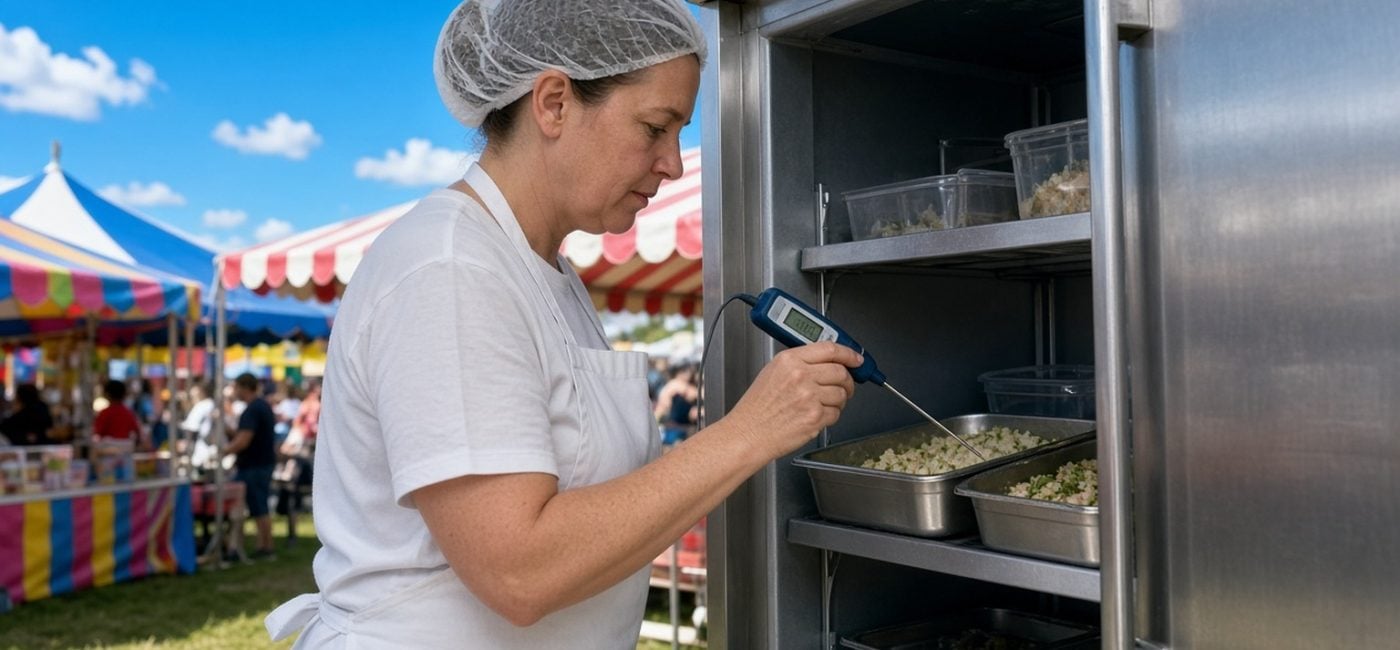
The refrigerator is warming, the electrician is on the way, and the vendor wants to keep selling until someone finds the fault. That puts two different decisions into one queue. Repairing the equipment is a facilities task. Determining what happens to the food is a food-safety task, and it cannot wait for a successful repair. A written fair refrigeration outage plan separates those decisions before the cooler warms.
For fair operators, refrigeration failure becomes manageable when the response separates people, product, equipment, and service. The plan needs evidence, authority, backup space, and a clear reopening decision. June is not the time to discover that everyone knows whom to call about a breaker but no one knows who can hold a pan of food.
Protect the food before diagnosing the machine
Start by identifying the affected equipment and stopping unapproved use of potentially affected food. Keep the refrigerator closed as appropriate, prevent casual transfers, and contact the designated food-safety lead. Facilities staff should address the equipment without being expected to decide whether the contents remain suitable for service.
The FDA's 2022 Food Code provides a model framework for time-and-temperature control, equipment, and responding to conditions that may create an imminent health hazard. Local adopted rules and environmental-health instructions govern the actual operation. Confirm those requirements before the fair, including when operations must stop and when approval is needed to resume.
Do not improvise a time-as-a-public-health-control procedure after the failure. Any such approach has specific conditions and must be established as required. A vendor cannot turn an unknown refrigeration history into a safe holding period simply by writing a new time on the container.
Build a usable timeline
The last documented acceptable reading matters because an air display alone may not reveal the food's history. Record when the problem was noticed, the last verified check, relevant product temperatures taken appropriately, door activity, recent deliveries, and any known interruption. Keep facts separate from estimates.
A statement that the cooler felt cold at opening is not a precise record. Nor does an equipment alarm prove exactly when every item became unsafe. Gather the information the responsible manager and health authority need, while avoiding repeated door openings that make conditions worse.
FDA's power-outage guidance emphasizes thermometers, advance planning, and evaluating food after an interruption. Its household examples are not automatic operating allowances for a commercial fair stand. Use the principles of evidence and preparation without copying consumer storage estimates into a concession's legal decision process.
Do not let a repaired unit erase the history
A functioning compressor can make the cabinet cold again while leaving the earlier exposure unresolved. The temperature at reopening does not prove that the product remained controlled throughout the event. The repair and the food disposition need separate signoffs by the appropriate people.
Consider a hypothetical stand whose refrigerator stops overnight. By midmorning the technician restores cooling, but no reliable record establishes the food's prior conditions. The question is not whether the machine now works. It is whether the available evidence and applicable requirements support using each affected product.
Avoid appearance, smell, or a taste test as a substitute for that decision. A manager under financial pressure may want a simple reassurance; the operating system should require a defensible evaluation instead. When safety cannot be established under the approved process, the answer cannot be invented to protect the day's sales.
Identify backup capacity before it is needed
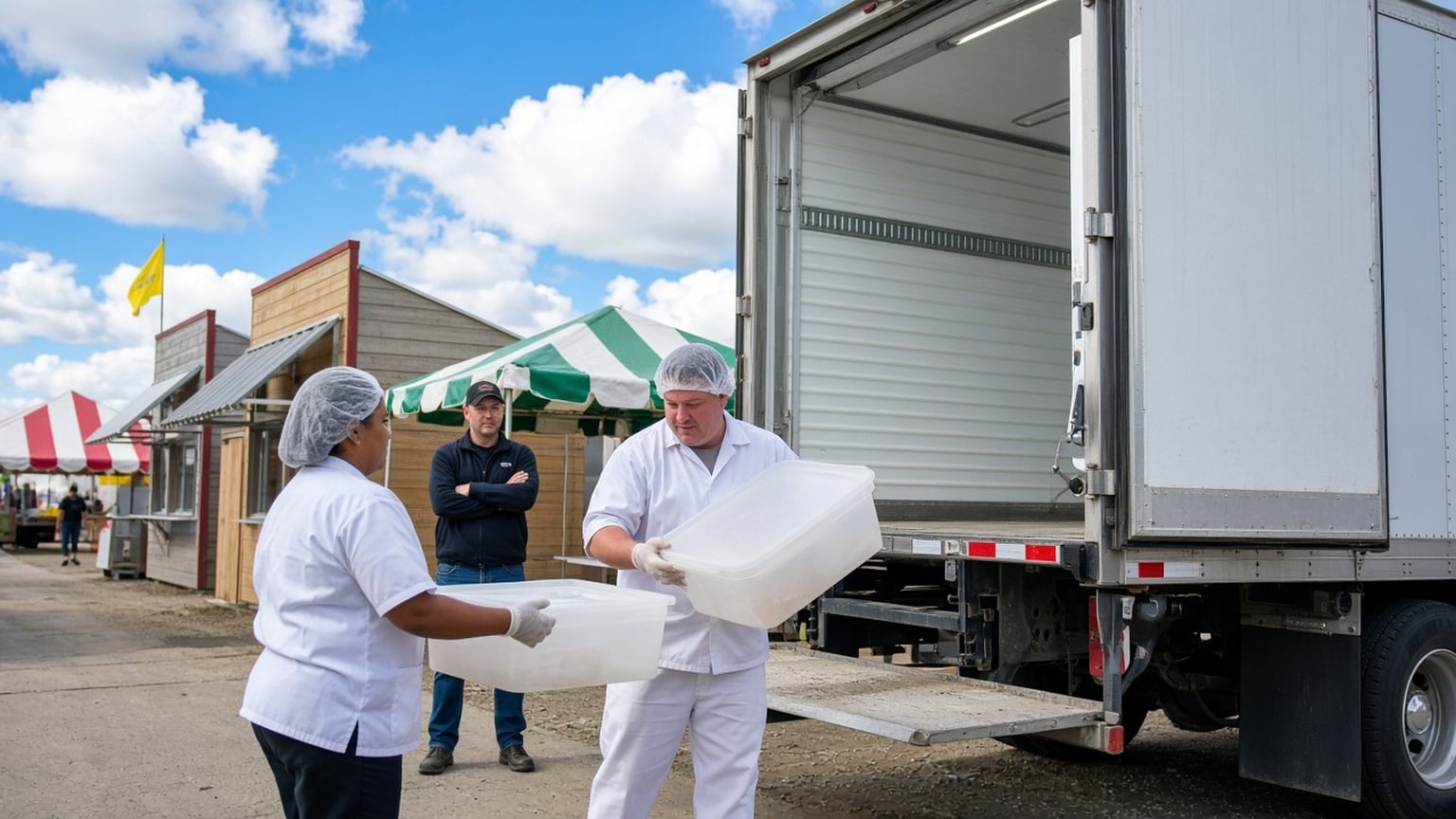
A spare refrigerator on the map is not necessarily available capacity. It may already be full, hold another vendor's product, require unavailable power, or be too far away for a controlled transfer. Confirm usable space, operating conditions, access, transport equipment, and the person authorized to allocate it.
Document how vendors request backup and how competing requests are prioritized. Emergency storage should not become a first-come scramble in which one operator moves unmarked containers into someone else's assigned space. The plan needs product identification, separation, custody, and a way to track what returns to which stand.
The SBA's emergency-preparedness guidance encourages planning for disruptions and continuity. Apply that idea to a realistic refrigeration scenario: who answers, what resources exist, how long transfer takes, and which service can continue safely. A supplier's phone number alone is not a continuity plan.
Move product only under a controlled decision
Transferring food does not correct an uncertain history. Obtain the appropriate direction first, then use suitable clean equipment, maintain identification, and control the route and timing. Record what moved, its destination, and the evidence supporting that action. Keep held product separate from food cleared for service.
Avoid mixing affected batches with unaffected inventory. That can expand the decision and make later traceability harder. Where the operator uses labels or hold tags, the system should be obvious to every shift and should not depend on one person's memory of which shelf is questionable.
Plan physical access as well. A backup trailer may require a key, a ramp, a trained operator, or a route that closes when guests arrive. Resolve those details before naming it in the emergency plan. Capacity that cannot be safely reached during service is not dependable backup.
A generator is not an instant solution
A portable generator may support some approved equipment, but it introduces electrical, fire, fuel, and exhaust questions. Only qualified people should assess the load, connection, placement, and applicable approvals. Do not run a cord from an improvised location because the refrigeration decision feels urgent.
CDC's carbon-monoxide guidance warns that generators must operate outdoors away from doors, windows, and vents. That public-health precaution is not a complete commercial installation design or permission to ignore fire and electrical requirements. A temporary power plan should be reviewed before the event and reassessed when conditions change.
If there is no approved safe power alternative, use another controlled fallback. That may mean moving eligible food, reducing the menu, or stopping service from the affected stand. Saving a refrigeration unit is not worth creating another hazard for workers or guests.
Give the vendor a service fallback
A vendor who sees only two options—sell everything or lose the day—faces the wrong operating incentive. Identify what can continue with unaffected equipment and approved ingredients. A limited menu, sealed products, or temporary closure of one station may preserve some service without pretending the failure did not happen.
The decision needs more than marketing approval. Confirm the revised operation with the responsible food-safety personnel and regulatory authority as required. Different preparation or storage arrangements can change the conditions under which the stand was approved. A neighboring vendor's spare countertop is not automatically a licensed extension of the kitchen.
Tell guest-facing staff exactly what is available and avoid promises about reopening times until they are realistic. A clear short menu is better than taking orders the stand cannot safely fulfill. Service recovery should support the food decision rather than pressure workers to reverse it.
Train the people who find the problem
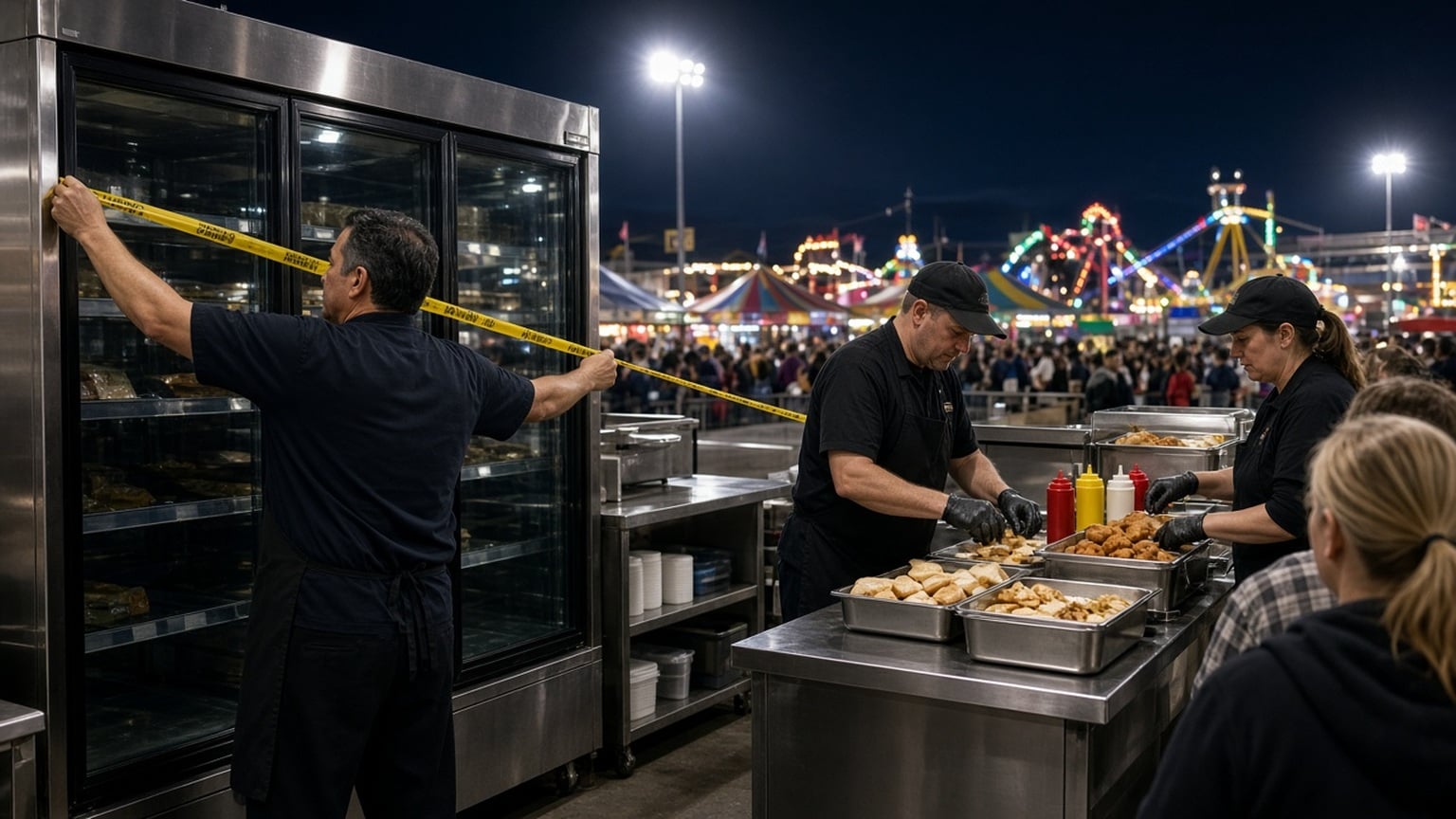
The first person to notice a warming unit may be a runner, cashier, cleaner, or overnight worker. Give those roles a simple reporting action: identify the equipment, protect against unauthorized use, and contact the designated lead. They should not need to diagnose refrigeration faults to recognize a condition that requires attention.
OSHA's training recommendations emphasize role-specific instruction and reporting hazards. Use a short walkthrough to show where the contact list, hold materials, thermometers, and backup arrangements are kept. Make the instructions understandable to every shift, including workers who arrive after the opening orientation.
Practice with an explicitly hypothetical failure. Ask who makes the equipment decision, who makes the food decision, and who communicates the service change. If every answer is call the electrician, the plan has not yet assigned the food-safety authority that the event needs.
Keep the financial record separate from the safety choice
Affected food has a cost, and vendors may need documentation for their own accounting, supplier discussions, or insurance review. Record facts accurately: product, quantity, ownership, relevant times, measurements, instructions, and disposition. Do not embellish a loss or promise that a particular claim will be covered.
Separating the financial record from the immediate safety decision reduces pressure to negotiate about food at the counter. The fair's agreements should clarify responsibility for equipment, utilities, maintenance, and service interruptions, with appropriate legal review. Those terms should be understood before a failure, not argued while a cooler warms.
After the event, examine causes without assuming that every incident is a maintenance failure. Door practices, load placement, overloaded capacity, power access, and delayed reporting can all matter. Use qualified technical review where needed and distinguish the confirmed cause from staff speculation.
Reopen with a clean handoff
Before resuming normal service, confirm that equipment is suitable and stable, affected food has a documented disposition, replacement supplies are acceptable, and required approvals have been obtained. Update the incoming shift so no one quietly returns held product to the line after the manager leaves.
Record who authorized the change and what restrictions remain. A temporary repair may require monitoring or a later service visit. The operating team should know whether the stand is fully restored or functioning under a controlled interim arrangement. That distinction matters when another busy period starts.
Reliable concession management treats refrigeration failure as a sequence of decisions, not a race to restart a compressor. Protect the product, establish the evidence, use approved alternatives, and communicate the service limits. The fair can recover from a broken machine more easily than from an unsupported food-safety choice.
# Decide who pays for readiness before a failure
Backup equipment, monitoring, transfer supplies, and qualified response all have costs. Assign those responsibilities in advance through the fair's reviewed agreements and operating budget. An emergency is a poor moment to discover that the vendor expected shared refrigeration while the fair expected every stand to bring its own reserve.
Keep the readiness decision distinct from a promise about losses. Paying for a backup service does not establish that every transfer is safe, guarantee that space will always be available, or determine insurance coverage. State the service limits honestly and ask vendors to plan within them.
Test access to those resources before opening. Confirm contacts, keys, power, loading arrangements, and after-hours support. A resource that exists but cannot be activated promptly may be less useful than a smaller, dependable alternative.
This review also helps the board prioritize spending. Rather than purchasing equipment because it sounds reassuring, management can identify the specific failure it addresses, the capacity it provides, and the remaining gap. Preparedness becomes an operating choice with clear limits, not a vague assurance that the fair has a plan.
Build your fair refrigeration outage plan
Schedule a consultation with FairFirst to review concession continuity, vendor responsibilities, backup resources, and the handoffs between facilities and food operations. Bring your equipment map and the interruptions your team has had trouble managing.
Technical and regulatory decisions belong with qualified professionals; the operating plan should connect them without delay. Talk with FairFirst before the next cooler failure becomes a rushed judgment call.
Sources
- Food Code 2022 and December 2024 Supplement — U.S. Food and Drug Administration
- Food and Water Safety During Power Outages and Floods — U.S. Food and Drug Administration
- Prepare for Emergencies — U.S. Small Business Administration
- Carbon Monoxide Poisoning Basics — Centers for Disease Control and Prevention
- Recommended Practices: Education and Training — Occupational Safety and Health Administration


