


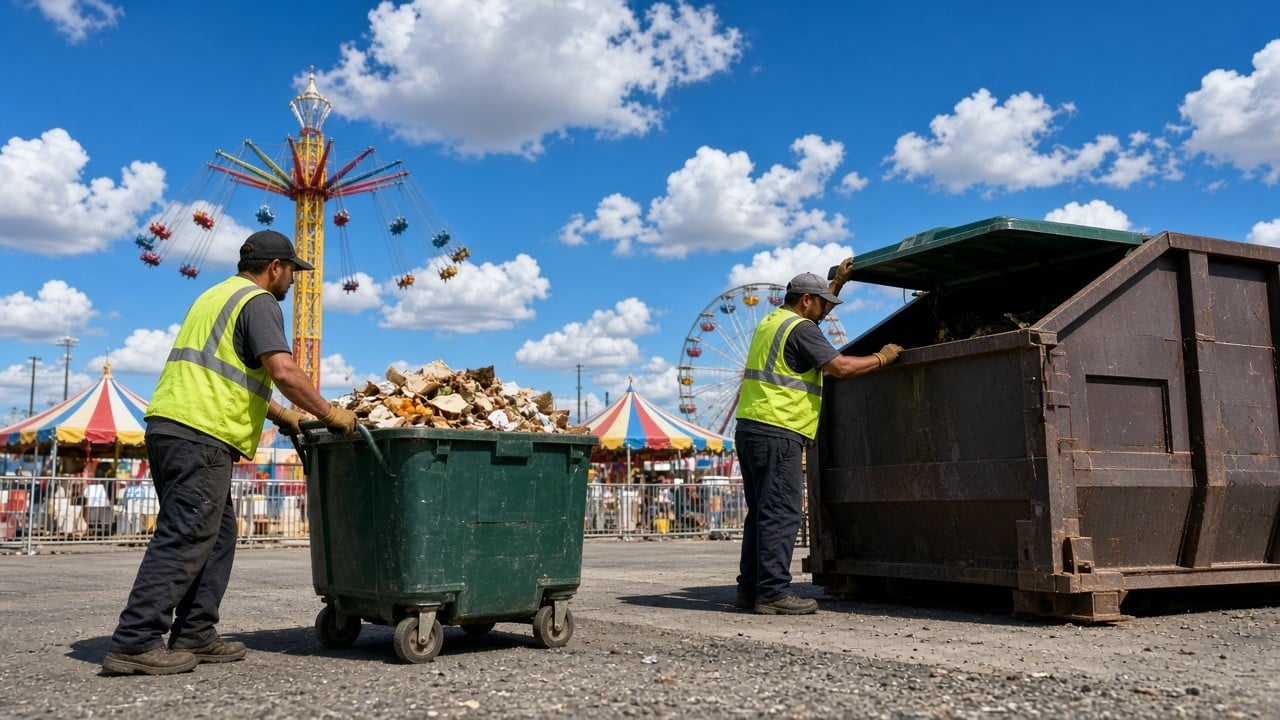
Every fair has the photo nobody wants on the front page: overflowing trash cans behind the food court on the last Sunday night, paper boats and soda cups spilling onto the asphalt, and a dumpster full of half-eaten food. For years, that was simply what a successful fair looked like. In 2026, it looks like a compliance problem and a public relations problem at the same time. This guide sorts out the fair waste and packaging rules that already apply and the vendor programs that help.
California has spent the last decade building a stack of waste and packaging laws, and several of them now apply directly to fairgrounds and the vendors who feed fair crowds. At the same time, guests, sponsors, and local officials are paying more attention to what fairs throw away. With contracts settling and packaging orders going in this spring, now is the time to get the food program ready. Here is what fair boards need to know, and the vendor programs that cut waste without taking the fun out of the fair.
The Fair Waste and Packaging Rules That Already Apply to Your Fairgrounds
Large venue and large event recycling requirements
California’s large venue and event recycling law, AB 2176, has been on the books since 2004. According to CalRecycle’s venues and events page, a “large venue” is a permanent facility that seats or serves an average of more than 2,000 people per day of operation, and fairgrounds are specifically named. A “large event” serves an average of more than 2,000 people per day and charges admission or is run by a local agency. Both staff and attendees count toward that number. Large venues and events must plan for solid waste reduction and report on their efforts to their local jurisdiction on request.
Almost every county fair in California clears the 2,000-person threshold on a normal day. If your fair has not reviewed its waste reduction plan recently, start there.
SB 1383: organics diversion and edible food recovery
SB 1383 is the state’s organic waste law, and it is the one with the most direct impact on food operations. CalRecycle states that all venues and events must divert organic materials from disposal, and that venues and events meeting the definition of a Tier 2 commercial edible food generator must arrange for the recovery of edible food that would otherwise be thrown away. Under the regulations, jurisdictions began inspecting Tier 2 generators for edible food recovery compliance on January 1, 2024, as explained in CalRecycle’s food recovery questions and answers.
In practice, that means two things for a fair. Food scraps and food-soiled paper need a path to composting instead of the landfill. And surplus edible food from vendors, such as unsold prepared items that were held safely, should go to a food recovery organization rather than a dumpster. There is a climate reason behind this push: the EPA estimates that about 58 percent of the methane released to the atmosphere from municipal solid waste landfills comes from landfilled food waste, according to its research on landfilled food waste.
Local organics ordinances
Counties and cities implement SB 1383 through local ordinances, and those ordinances are what inspectors enforce. In Alameda County, StopWaste, the public agency that serves as the county’s waste management authority, adopted the Organics Reduction and Recycling Ordinance (ORRO), which took effect January 1, 2022. ORRO requires businesses and other covered properties to subscribe to compost and recycling service, separate organics and recyclables from trash, and set up properly labeled bins. It also lists large venues among the Tier 2 edible food generators with food recovery obligations. Other counties have similar ordinances, so check yours.
The Packaging Rules Changing What Vendors Can Hand Out
The foam container era is over
If any of your vendors still serve food in polystyrene foam clamshells or cups, that has to stop. Under SB 54, producers of expanded polystyrene (EPS) food service ware had to show a 25 percent recycling rate by January 1, 2025. CalRecycle’s EPS food service ware page states that the rate has not been met, so producers are restricted from selling, distributing, or importing EPS food service ware, including cups, plates, bowls, clamshells, trays, and lids, in California. Vendors may still have old stock in storage. Make “no foam” an explicit contract term.
SB 54 is reshaping all single-use packaging
The broader SB 54 packaging law, signed in 2022, requires that by 2032 California cut single-use plastic packaging and plastic food service ware by 25 percent, recycle 65 percent of it, and ensure that 100 percent of single-use packaging and plastic food service ware is recyclable or compostable. The law puts primary responsibility on producers through an extended producer responsibility program, and CalRecycle is still working through implementation. For fairs, the practical effect is that the packaging your vendors buy will keep changing over the next few years, and the cheapest plastic options are the ones most likely to disappear or get more expensive.
Accessories only on request
Since AB 1276 took effect, California food facilities may not hand out single-use utensils, straws, stirrers, condiment cups, or condiment packets unless the customer asks for them, and those items cannot be bundled together. The text of AB 1276 allows self-service dispensers that release one item at a time and encourages bulk condiment dispensers. A fair vendor is a food facility, so the rule applies at the booth window. It is also an easy way to cut costs.
Local foodware ordinances are coming
Some cities are going further. StopWaste publishes a model ordinance for food service packaging reduction and reuse that Alameda County cities can adopt in whole or in part. Its options include standards for disposable foodware, restrictions on foam and certain non-recyclable, non-compostable products, and returnable reusable beverage cups at large venues and events. In the event module, event producers would start by serving at least 25 percent of non-packaged beverages in reusable cups and move to 100 percent over time. It is a model, not a countywide mandate, but it shows where local policy is heading.
Why Public Pressure Is Rising Too
Laws are only part of the story. Fairs are community institutions, often on public land, and many depend on public funding and local goodwill. Guests post photos of overflowing bins. Local officials who have spent years rolling out compost programs notice when the biggest event in the county seems to ignore them. Sponsors increasingly want to be associated with events that look well run and responsible. A visible waste program has become part of a fair’s reputation, just like clean restrooms and safe rides.
Vendor Programs That Cut Waste Without Killing the Fun
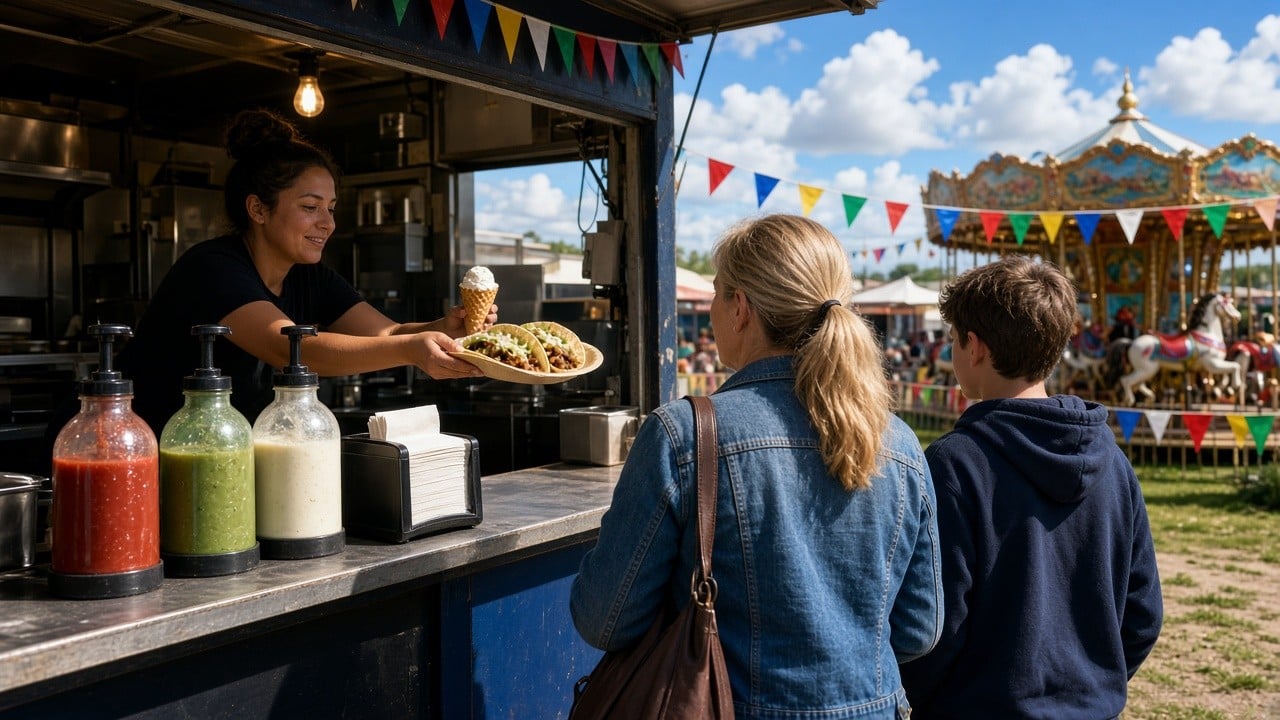
The good news is that fair food has a head start. Many classics are already served in edible or minimal packaging. Corn dogs come on a stick. Ice cream comes in a cone. Tacos are their own plate. The goal is to build on that, not to turn the midway into a lecture.
1. Standardize compostable foodware across the food court
When every vendor uses different materials, guests cannot sort correctly and compost gets contaminated. A managed food program can specify approved compostable or recyclable items that match what your local hauler accepts, then coordinate purchasing so vendors pay less. One consistent set of materials makes sorting far simpler.
2. Lean into edible and minimal packaging
Encourage menu formats that need less packaging: items on a stick, food served in cones, bread bowls, tortilla bowls, and waffle cones for savory items. Edible wrappers and cups are an emerging option for some items. They are worth testing for novelty and marketing value, even if they will not replace a paper boat everywhere.
3. Staff the sorting stations
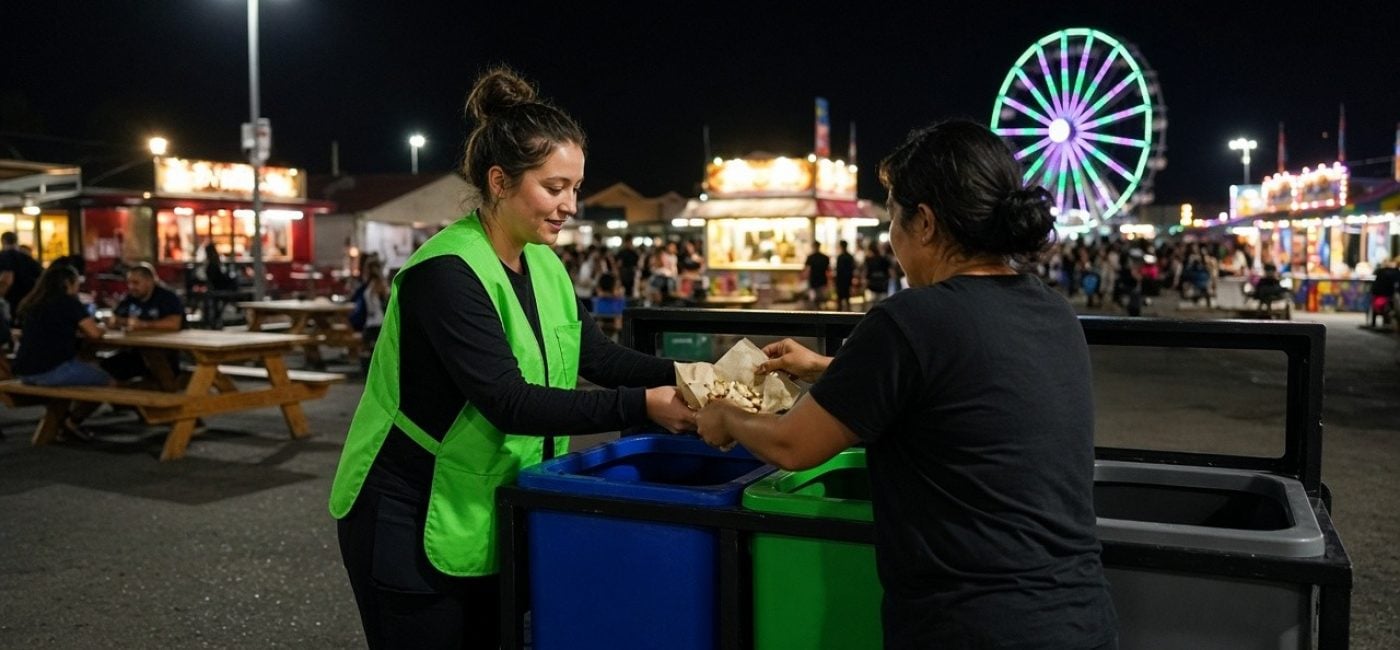
Unstaffed three-bin stations usually end up as three trash cans. Staffed stations, often run by volunteers, youth groups, or green teams, keep compost clean and give guests a quick lesson. Put them where food is eaten, not just where it is bought, and use simple picture signage.
4. Build edible food recovery into vendor contracts
Line up a food recovery organization before the fair, set pickup times, and require vendors to participate with safely held surplus food. Track pounds donated. It satisfies SB 1383 expectations and gives your fair a positive story to share.
5. Go accessories-on-request and bulk
Make AB 1276 compliance standard practice: utensils and straws on request, bulk condiment pumps instead of packets, and napkin dispensers instead of handfuls. Vendors save money and the bins fill more slowly.
6. Pilot reusable cups where it makes sense
Beer gardens, wine tastings, and souvenir drink programs are natural places to test reusable or returnable cups with a deposit. Start small, measure participation, and expand what works.
7. Measure and report
Weigh compost, recycling, landfill, and donated food. Those numbers satisfy reporting requests from your local jurisdiction, show progress year over year, and give the board something concrete to point to when questions come up.
Your Spring Waste Checklist
With the fair season a few months away, these are the questions to settle before vendors place their packaging orders:
- Has your fair’s large venue or event waste reduction plan been updated, and do you know who at your city or county would request a report?
- Does your hauler provide organics collection on the fairgrounds, and which compostable materials does it actually accept?
- Do vendor contracts ban foam foodware and require accessories only on request?
- Is a food recovery organization lined up, with pickup times and a simple way for vendors to log donations?
- Who will staff sorting stations, and where will they be placed relative to seating areas?
- Has your city adopted any local foodware or reusable cup rules that apply to events?
None of these items is expensive on its own. What makes waste programs fail is leaving them to the last two weeks before opening day, when vendors have already bought a season’s worth of the wrong containers.
Talk to FairFirst Before Your Next Fair
FairFirst manages food concessions for county fairs, including the Alameda County Fair. We build waste reduction into the food program from the start: standardized compostable foodware, vendor contracts that cover foam, accessories, and food recovery, coordinated purchasing, and on-site management that keeps sorting stations working. If your board is facing new waste rules or a trash photo it never wants to see again, schedule a consultation with FairFirst and we will help you build a 2026 food program that is cleaner, compliant, and still the best part of the fair.
Book your free FairFirst consultation today.
Sources
- Venues and Events Laws, CalRecycle, 2025
- SB 1383 Food Recovery Questions and Answers, CalRecycle, 2025
- Expanded Polystyrene (EPS) Food Service Ware Requirements, CalRecycle, 2025
- SB 54: Plastic Pollution Prevention and Packaging Producer Responsibility Act, CalRecycle, 2025
- AB 1276, Single-Use Foodware Accessories and Standard Condiments, California Legislative Information, 2021
- Organics Reduction and Recycling Ordinance (ORRO), StopWaste (Alameda County Waste Management Authority), 2025
- StopWaste Model Ordinance for Food Service Packaging Reduction and Reuse, StopWaste, 2026
- Quantifying Methane Emissions from Landfilled Food Waste, U.S. Environmental Protection Agency, 2023


