


Somewhere in your stack of 2026 vendor contracts there is probably a line, or a board member’s note, about “healthy options.” Maybe it came from a public health partner. Maybe a supervisor brought it up after the new federal Dietary Guidelines came out in January. Maybe your fair has required it for years and nobody has enforced it. Either way, the healthy food item is back on the agenda, and most fair managers know what usually happens next: a sad fruit cup sits in a cooler all week, vendors grumble, and the board concludes that “healthy doesn’t sell at the fair.” Healthy fair food can sell when it is planned like any other menu item.
It does not have to go that way. Healthy items sell when they are designed to compete with fair food on its own terms: big flavor, generous look, great smell, and a price that feels fair. Here is what is actually driving the push in 2026, what the rules really say, and the menu strategies that make it work.
Is There Actually a “Healthy Food Item” Mandate?
Let us be precise, because this matters when your board discusses it. There is no California statute that requires county fairs or their concessionaires to sell a healthy food item. What exists is a patchwork of fair-level policies, public health guidance, and one specific state rule that many vendors overlook.
Fair-level requirements are real, and some have been around for years
Some fairs write healthy-item requirements directly into their vendor contracts. The Marin County Fair, run by the County of Marin, is a clear example. Its 2026 Food Concessionaire Handbook states that since 2008, the fair has required every food concessionaire to offer at least one Healthy Food Choice. Vendors list the item separately on their application with nutrition facts, and a dietitian reviews it.
Marin’s standards are specific. A qualifying item must represent at least one major food group, such as whole grains, fruits, vegetables, low-fat dairy, or lean protein. It must be prepared raw, steamed, baked, grilled, or sautéed with no added sweeteners or fats, and served in appropriate portions. It also has to meet calorie, sodium, fat, and sugar limits modeled on state guidelines for schools and vending. For example, entrées are limited to 350 calories and 480 milligrams of sodium.
That last detail is important for menu planning. A deep-fried cauliflower “wing” might feel like a healthy swap, but under a standard like Marin’s it would not qualify. If your fair adopts a requirement, the definition you choose determines which menu items count.
Federal guidance changed the conversation in January
On January 7, 2026, USDA and HHS released the Dietary Guidelines for Americans, 2025–2030, built around the message “eat real food.” The guidelines emphasize protein at every meal, whole vegetables and fruits, full-fat dairy without added sugars, and limiting highly processed foods, added sugars, and artificial additives. The full guidance is at RealFood.gov.
The Dietary Guidelines do not regulate fair concessions. But they shape what public health departments, school programs, and many county agencies promote, and that filters into the expectations of fair boards and sponsors. Notice too that the new guidance is friendlier to grilled meats and real dairy than earlier versions, which opens up menu options that fair guests already love.
Public health agencies are pushing healthier concessions
The CDC promotes food service guidelines as standards for healthier food and beverages in community settings, and it specifically lists parks, stadiums, and concession stands as places to use them. Those guidelines include behavioral design, which means making the healthier choice the easy, visible, attractive choice. County health departments often draw on this model when they work with local venues, which is one reason the topic keeps coming up at fair board meetings.
The one state rule that does apply: kids’ meal drinks
California’s Healthy-by-Default Children’s Meal Beverage Law, SB 1192, has been in effect since January 1, 2019. According to the California Department of Public Health fact sheet, any restaurant that sells a children’s meal that includes a beverage must make the default drink water, sparkling or flavored water with no added sweeteners, unflavored milk, or a nondairy milk alternative with no more than 130 calories per serving. Customers can still request another drink.
The law defines a restaurant as a retail food establishment that prepares, serves, and vends food directly to the consumer, and the children’s meals chapter of CalCode is enforced by local environmental health agencies. If a vendor at your fair sells a “kids’ combo” with a drink at a single price, the default drink should be water or milk, not soda or lemonade. Check with your county environmental health department on how it applies this to temporary booths, but setting the default correctly is simple and costs nothing.
Why Healthy Items Usually Fail at Fairs
When healthy items flop, it is rarely because guests refuse to eat vegetables. It is usually because of how the items are chosen and presented.
- They look like a compromise. A small plastic cup of melon next to a sizzling turkey leg never wins.
- They are hidden. Listed at the bottom of the menu board, with no photo and no sampling.
- They are priced wrong. A $12 salad sitting next to a $9 corn dog sends guests to the corn dog.
- They are not built for fair operations. Delicate items wilt in the heat and slow down the line.
- Vendors do not believe in them. When the operator treats the item as a box to check, guests can tell.
Menu Ideas That Satisfy Boards and Crowds
The goal is food that a guest would choose even if it were not labeled healthy. Here are concepts that fit fair operations well. Exact nutrition will depend on each vendor’s recipe and portion, so any item intended to meet a specific standard should be checked against that standard.
Grilled and charred proteins
Grilled chicken skewers with a bright herb or citrus marinade, salmon or fish tacos on corn tortillas with cabbage slaw, and sliced tri-tip with grilled vegetables all have the smoke, smell, and visual drama of fair food. They are also easy to portion and hold up well during a rush. Live-fire cooking at the front of a booth is the best advertising a stand can have.
Hearty plant-based bowls
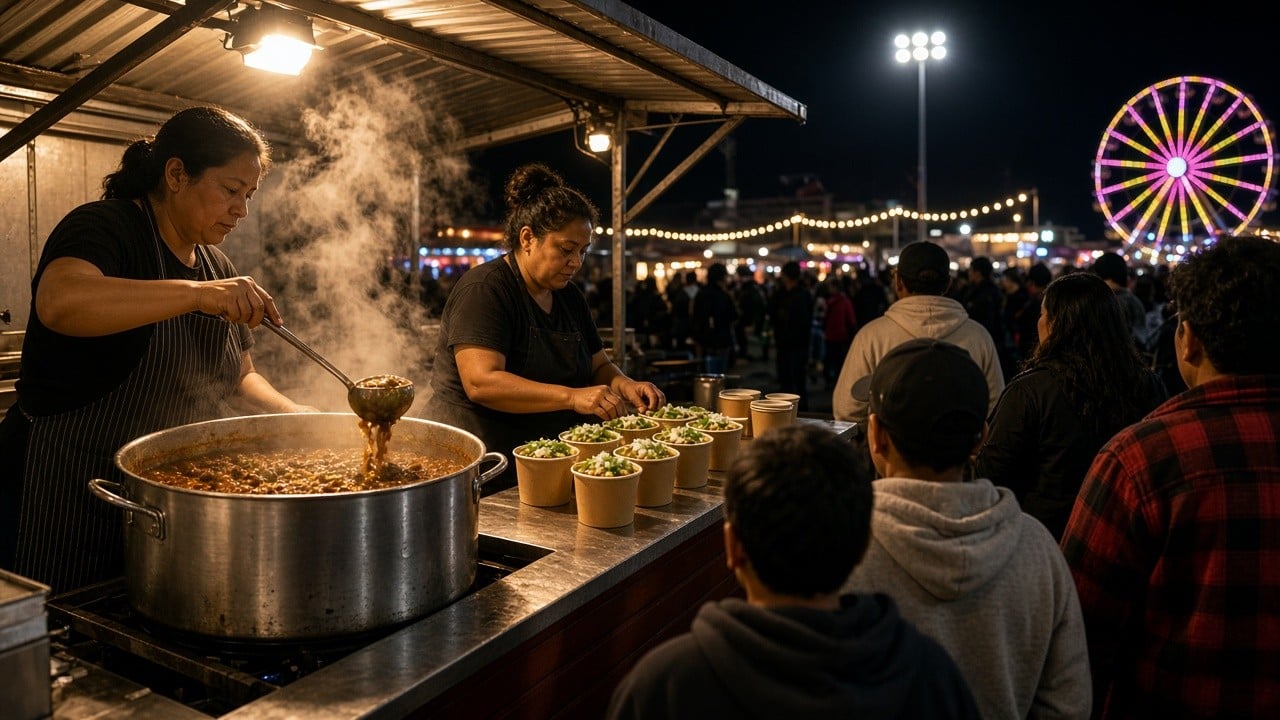
Lentil or three-bean chili, black bean and roasted corn bowls, and falafel with cucumber salad offer fiber and protein and can be held hot safely in batches. Chili in particular is familiar comfort food, and it can be built in a cup for easy eating on the move.
Cauliflower “wings,” done right
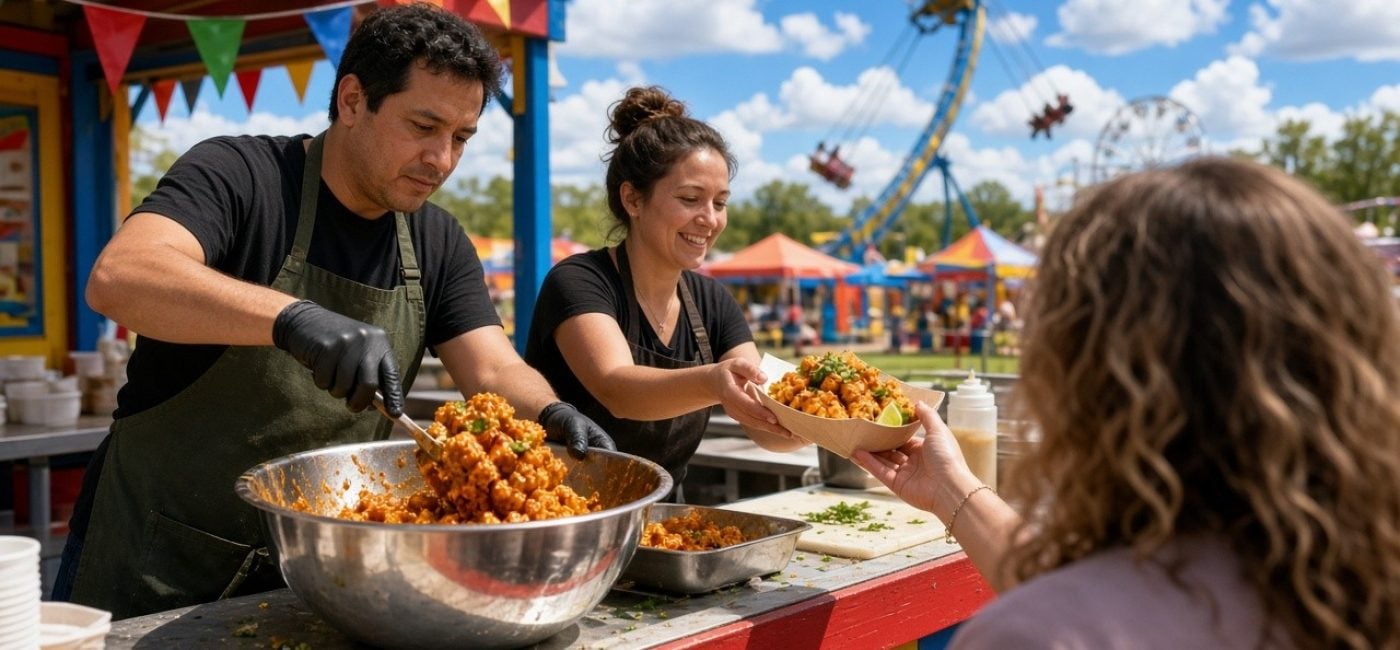
Roasted or air-baked cauliflower tossed in buffalo, gochujang, or garlic-herb sauce gives guests the shareable, saucy experience of wings. To meet a strict standard like Marin’s, it needs to be baked or roasted rather than deep-fried, with attention to sodium in the sauce. Served in a paper boat with a squeeze of lime, it looks like fair food because it is fair food.
Fresh produce with a show
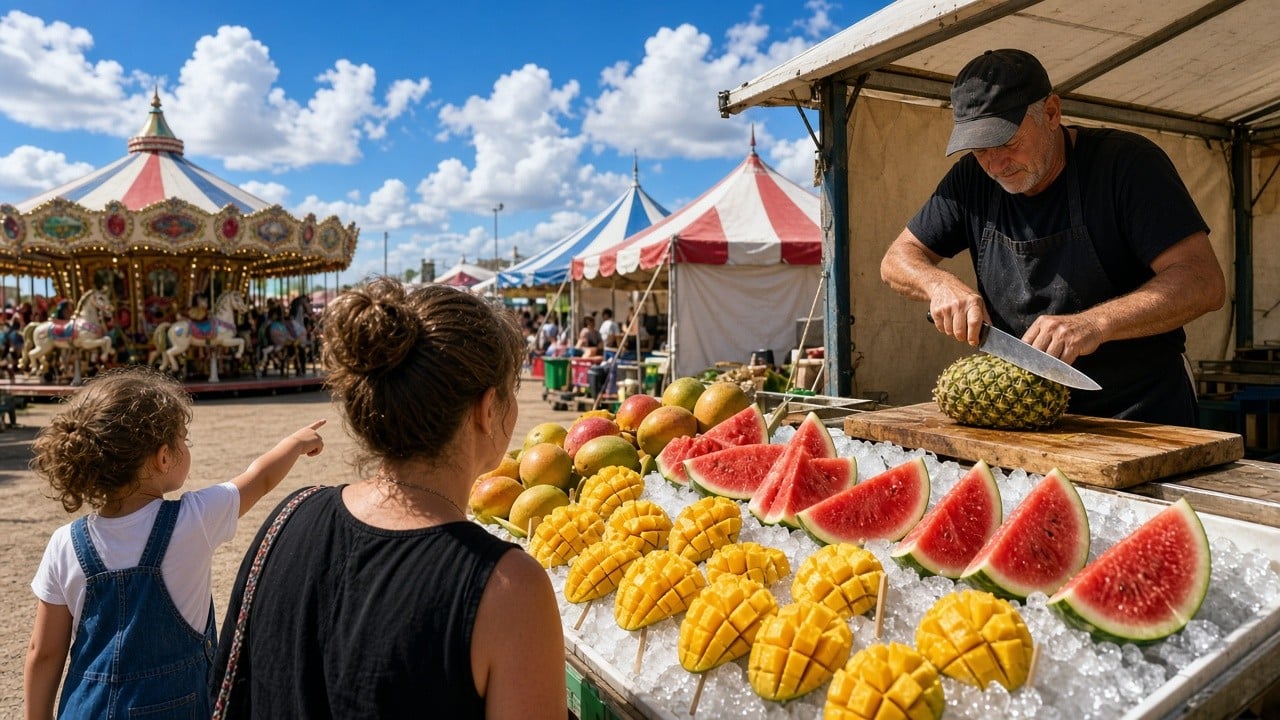
Fruit cups do better when they are cut in front of the guest, sold on a stick, or served in a carved pineapple, with chile-lime seasoning on the side. Elote-style corn can be offered grilled with lighter toppings. Watermelon wedges sell themselves on a hot afternoon when they are displayed on ice where people can see them.
Better-for-you drinks
Agua fresca made with real fruit and less sugar, unsweetened iced tea, and infused water stations meet a real need in summer heat. Pair them with kids’ meals to satisfy the default beverage rule and give families an easy yes.
The Cost Case Vendors Often Miss
Vendors sometimes resist healthy items because they assume the ingredients cost more. Recent price data says otherwise for many of them. In the 12 months ending November 2025, the BLS Consumer Price Index showed beef and veal up 15.8 percent, while chicken rose 1.3 percent, dried beans, peas, and lentils rose 1.8 percent, fresh fruits and vegetables slipped 0.2 percent, and potatoes fell 3.7 percent. A lentil chili, a chicken skewer, or a roasted vegetable bowl can carry a healthier food cost than a beef-heavy specialty plate. That gives vendors room to price healthy items competitively without giving up margin, which is exactly what makes them sell.
How to Make Healthy Fair Food Actually Sell
- Put them in high-traffic spots. Do not bury the healthy-concept stand at the end of a dead aisle. Place it where crowds already flow.
- Price them to compete. Keep healthy items at or near the price of comparable classics. A slightly thinner margin on one item is a small price for a requirement that works.
- Lead with flavor in the description. “Fire-grilled citrus chicken skewer” sells. “Healthy chicken option” does not.
- Use sampling and live cooking. Smell and sight drive fair purchases more than menus do.
- Feature them in fair marketing. Include healthy items in your food guide, social posts, and media tours. It gives the board a story to tell and helps guests find them.
- Track sales by item. Measure what moves, drop what does not, and share results with vendors so the program improves each year.
Setting a Policy That Works
If your board wants a healthy-item requirement, write it clearly. Define what qualifies, using a recognized standard. Decide who reviews submissions and when. Make the requirement part of the vendor application, not a surprise at contract time. And build in flexibility for each vendor’s concept: a funnel cake stand might qualify with a fresh fruit topping option, while a barbecue stand might offer a grilled chicken plate with vegetables.
The fairs that get this right treat healthy items as part of the food program’s design, not a compliance afterthought. The result is a midway that serves every guest, from the family looking for something lighter to the guest who came for a bacon-wrapped turkey leg, and a board that can answer public health questions with confidence.
Talk to FairFirst Before Your Next Fair
FairFirst manages food concessions for county fairs, including the Alameda County Fair. We help fair boards design healthy-item policies that make sense, work with vendors to develop items guests actually buy, and place and promote those items so they sell. If your board is weighing a healthy food requirement for 2026, schedule a consultation with FairFirst and we will help you build a program that satisfies both your board and your crowds.
Book your free FairFirst consultation today.
Sources
- 2026 Food Concessionaire Handbook, Marin County Fair (County of Marin), 2026
- Kennedy, Rollins Unveil Historic Reset of U.S. Nutrition Policy, U.S. Department of Agriculture, 2026
- Dietary Guidelines for Americans, 2025–2030 (RealFood.gov), U.S. Department of Health and Human Services and U.S. Department of Agriculture, 2026
- Food Service Guidelines, Centers for Disease Control and Prevention, 2024
- SB 1192 Fact Sheet: Healthy by Default Children’s Meals Beverage Law, California Department of Public Health, 2024
- California Retail Food Code (CalCode), Alameda County Department of Environmental Health, 2026
- Consumer Price Index, November 2025, U.S. Bureau of Labor Statistics, 2025


